Saturday, June 26, 2010

Rule of Thumb #11: No storm, no sunshine

[My apologies to those who were loyally following this little series. It started off as a “weekly” series, later became a “bi-monthy series, and it’s now a “whenever the hell I have time” series.]


Day 23: June 6, 2007. Park City, Utah to Aurora, Colorado (511 miles)

Hail, sleet, rain, snow. A dreary, overcast sky lavishly hosed me with every cruel form of matter it could devise. For eight hours I stood on an entrance ramp to the I-80 in Park City, Utah. My cardboard sign to “Cheyenne” got so wet the “enne” was about to tear off down the middle crease, half because of the unremitting rain, and half because my numb fingers couldn't keep the sign from falling into the puddle forming around my feet.

Oh, how I hated. I hated each and every goddamned driver that left me standing there alone, hungry, cold and poor. How could they let someone suffer when all they had to do was pull over and take me as far as they were going? Why are they all so heartless?!

As each car approached, I flashed an innocent half-smile (as I always would), hoping to give drivers the impression that I was harmless. But as each passed me by, I snarled, stomped my foot, and let loose a flurry of curse words that dribbled from my lips like venom.

To their credit, with the way I looked, I doubt I would have picked me up either. I was wearing a navy blue rain suit with a large conical KKK-type hood that made me look like a deranged fisherman. I bought the rain suit from Wal-Mart for $10—a misguided purchase considering how little the suit did to stanch the ingressing rivulets of rain that saturated my underclothing. Behind me, my pack sat upright covered with a giant black industrial garbage bag that fluttered in the wind. No wonder no one was pulling over. I looked less like a daring adventurer and more like a bum trying to carry his trash across state lines.

I needed to regroup. I went to a nearby gas station, bought a cappuccino, warmed up, ate my third peanut butter and jelly sandwich of the day, and made a new sign—this time reading “Wyoming.” I decided that I’d try to hitch a ride until this new cardboard sign falls apart, which—at the rate the rain/snow was falling—gave me about an hour before I’d be forced to head back to the Mormon Church or find somewhere else to bed down for the night.

While I was redrawing my sign by the gas pumps, a man filling up his white pickup—who’d supposedly seen me standing at the entrance ramp earlier—looked at me and, shaking his head, said, “You’re crazy, man.”

I had had enough. Too often had hundreds (thousands!) of vehicles on this road and on others passed me without even deigning to look at me. Too often had vehicles with empty front and back seats heading in my direction insensitively zipped by. And now this insolent bastard was calling me crazy.

“You know what asshole,” I said, incensed. “I’m here freezing my balls off and you and your no-good state has the gall to let a guy who needs a ride freeze on the side of the road. Crazy? Crazy for coming to Utah—this hellhole—that’s for sure.”

“Listen, kid…” he said conciliatorily.

“No. You listen to me. I’ve been out here for eight goddamn hours. Now unless you’re going offer me a ride, I’d keep your trap shut and start minding your own business.” I said the last part while threateningly sliding my sleeves up my biceps.

“Sorry, man," he said. "How bout I take you to the next town? Looks like you could use a warm meal too.”

That’s how the dialogue ideally would have unfolded. Instead, exhausted and demoralized, I silently watched him fill up his tank. Besides, I thought, maybe he’s right.

The rain looked like it’d never stop. Slowly, the creases of my new square of cardboard, sopping wet, began to tear. I was moments away from losing the “ing” of my “Wyoming” when I heard someone honking behind me.

She was gorgeous. She was tall, and her long blond hair poured down her shoulders from beneath a cab driver’s cap. She wore checkered pants and high heels. She looked like she might have been 30. She also looked a little kooky and crazy (maybe even a little kinky). She told me she was a single mom and was heading to Coalville, just a few miles up the road.

I had, up until then, turned down really short rides, but I was sick of Park City and desired the solace of a warm car if just for a few minutes. Our conversation was short and spare, but she gave me her number and told me I could stay at her place that night if I wanted to.

I had no reason to believe the offer was anything but platonic, yet I couldn’t stop myself from fantasizing.

This is what you wanted, isn’t it Ken? A few weeks to live outside of rules and laws and conventions. A few weeks of liberty. A few weeks to experience life as fully as I possibly could: loving, hating, surviving, saving—hell—killing if I had to; whatever it took, so long as I felt like I was truly living for once.

But then I thought of Natalia back in Oregon, probably still upset about my absence and how we parted without “figuring out” how to deal with our long-distanced relationship.

I told her that, yeah, it was getting late and that it would probably be a good idea for me to call it a day. “Sure,” I said. “I’d love a place to stay.”

I took a shower, put on a pair of dry clothing and sat on her couch where she brought over a can of Bud for me and a glass of wine for her. She told me all about her ex, and how he left her and her daughter with nothing. “It’s so lonely in Coalville,” she said. “If only I had someone to keep me company once in a while.”

I put the beer down, leant over and pressed my nose against her cheek…

Instead of letting the events transpire in such fashion, I accepted the piece of paper she wrote her number on, which I knew I’d never call, even if I were to get stuck in Coalville.

I sat down on a curb and started making a new sign outside of a mom-and-pop convenience store called Sinclair’s. My new sign was for “Evanston”—a town just inside the Wyoming border that I could get to if I got lucky with a quick ride.

As I was putting the finishing touches on my sign, a black kid in his late teens came up to me wondering what I was doing. After telling him where I’d come from and where I was headed, he seemed to be in state of amused disbelief. I thought he might have been inspired with my journey but he instead told me, “You should save up your money and do it when you’re older. When you can really experience the country.”

“Nah, man,” I said grinning. “There’s no adventure in that. With age and money, comes kids, wife, security. You gotta do it when you’re young and free.”

He got a call on his cell phone and I got back to work on my sign. We shook hands and wished each other luck.

Fifteen minutes go by and a tall ranch-owner picked me up and took me to Evanston while we listened to Crosby, Stills, Nash, and Young on the radio. He dropped me off at an Arby’s in Evanston. In the bathroom, I cleaned myself up, hoping to land one more ride before nightfall.

After an hour, Travis pulled over.

“I’m going all the way,” he said, referring to my sign to Cheyenne. “I know you, by the way.”

“You do?”

“Yeah, your name’s Nate, right?”

“Umm. No. My name’s Ken.”

“Well, I suppose you can ride with me anyway.”

Travis had just come back early from a trip to Italy. Italians, he said, were “a bunch of thieves.”

He was young, maybe 25, and headed to Colorado where he was a grad student at the University of Denver, specializing in artificial intelligence.

He said he wanted to “crack the code” on AI technology by being the first to create a machine that can adapt and evolve on its own. It was delightful conversation and to amuse him I freely told him my most eccentric ideas and philosophies.

Like on all my long rides with drivers, we’d share intimate details freely, knowing that we’d never see each other again. He told me about how his girlfriends have all cheated on him, and bemoaned how there were no good women left.

“Spanish girls,” he said. “I need a Spanish girl. They’re chill and full of passion. They wouldn’t cheat on me.”

I told him of my own Spanish girl, and how she’d never betray me. Before we said goodbye, Natalia told me she’d follow me anywhere. Some might be quick to point out how I had it all: a girl and the freedom to roam. But whether in Alaska, Mongolia, or on Mars, I knew—no matter where I went—unless I had no binding human attachments, I’d never feel how I did right then and there, sharing stories with a stranger, listening to the wheels purr atop prairie-flat interstate songlines, soaring beneath constellations sparkling in a chrome-blue Wyoming sky, lazily watching the conveyor belt of yellow dashes—their passing reminding me of how far I’d come and how the road—a means to get from one home to another—came to be a home in itself, one that I’d embrace in storm and sunshine, love and hate: my dear, dear, open road.

Wednesday, June 16, 2010

The Inhabitants of Acorn Abbey


I’m in Stokes County, North Carolina—home to a sparsely-populated scattering of doublewides and country villages, 45-minutes north of Winston-Salem, the nearest urban center. In Stokes County there are three “No Trespassing” signs per capita, the median age is 67, and one-syllable curse words are drawn out into raspy haikus. Picture rolling green hills, winding country roads, corn rows, cabbage heads, and farmer-tanned arms dangling out the windows of well-polished pickups.

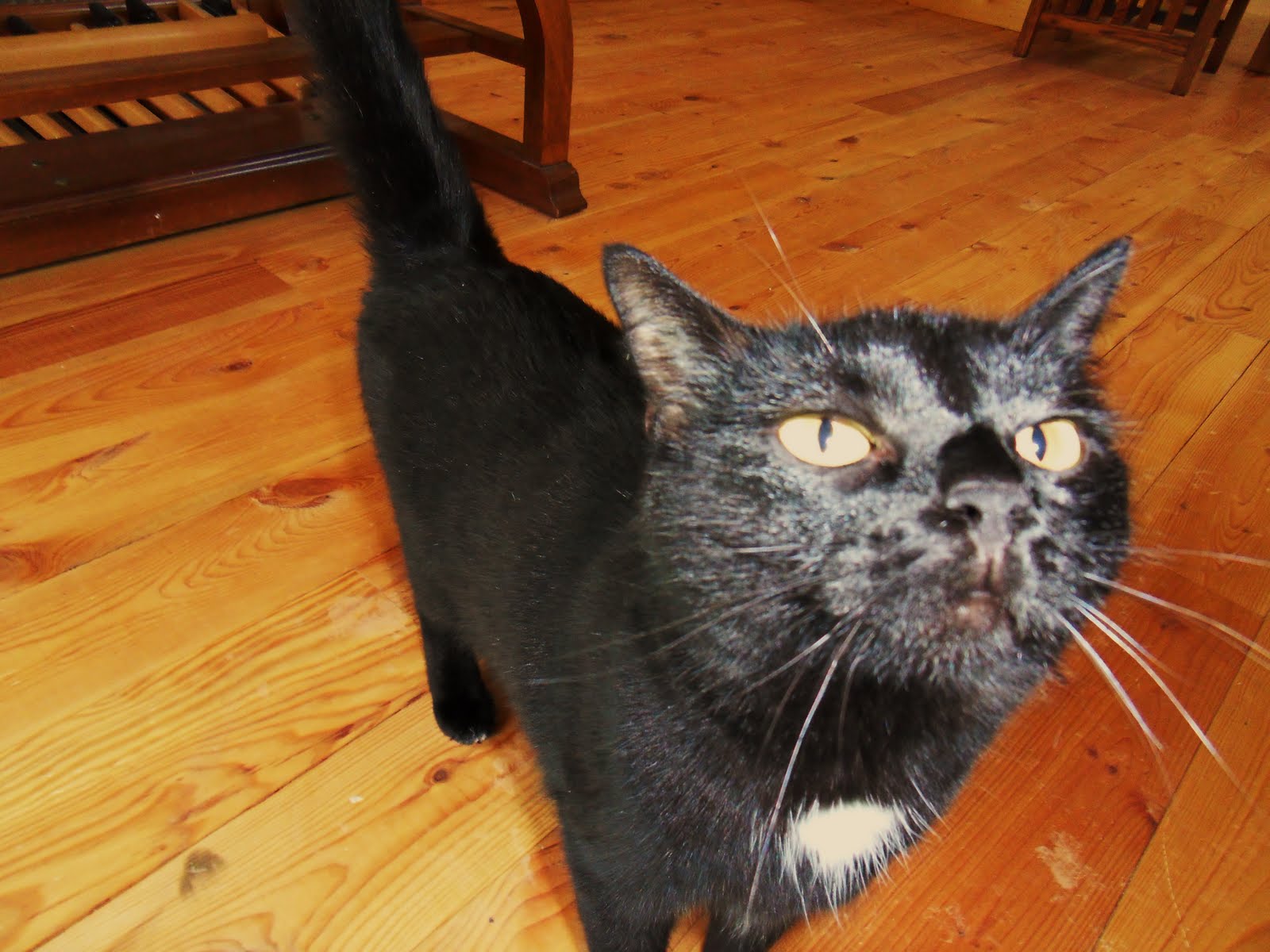
For the last month I’ve been living with a hermit (David), his cat (Lily), and his four chickens in his newly built home called Acorn Abbey. It’s a small, steep-roofed Gothic revival cottage nestled in the woods on a seldom-traveled gravel road about a half-dozen miles from the nearest town (Danbury, N.C. pop. 108). He thinks of it as a modern-day monastery and of himself, a monk, quietly living out his days with his books and garden.

David, 61, has recently retired from 30 years in the newspaper business. He will measure the success of his retirement by how well he can roll the clock back to 1935—when the farms were small and the people, self-reliant.

In years to come, the Abbey will support a fully-sustainable organic vegetable garden, an orchard of fruit trees—apples, pears, peaches, and figs, as well as grapes and blueberries—and his home will be—as he wishes it—entangled with vines, trees, and flowers, creeping, crawling, and buzzing with life.

For room and board, I’ve volunteered to be his groundskeeper. Because living in the van in temperatures commonly exceeding 95 degrees Fahrenheit was darn-near inconceivable, I needed a temporary upgrade.

While David in many ways is living a minimalist lifestyle, he does enjoy some of the finer things that have become alien to me these past few years. For instance, we have banana-nutmeg smoothies every morning and elegantly-prepared meals for lunch and supper. He likes to serve a glass of wine with dinner. We use napkins, plates, and silverware. We don’t eat out of the pot, we wash our dishes, and we communicate—oddly—not with an alphabet of snarls, grunts, farts, and chest-poundings, but with refined conversation.

David and I are both out-of-the-closet introverts so we preserve each other’s sanity by giving each other plenty of space and privacy. It’s common that we go almost an entire day without saying a word to one another. When working side-by-side in the garden, we’re like a pair of tight-lipped Amish men too focused on our work or the thoughts hurling through our heads to emit noise for no good reason.

At mealtime though, our thoughts, pent up from hours of reticence, unfurl in a thousand colors. We discuss UFO sightings, doomsday scenarios, minimalist philosophies, Joan of Arc, Asimov, Thoreau, and our life histories. Stokes County is our own little Concord, Massachusetts—and we’re a couple of nuts marooned on five acres of hillside where we can do things our own way.

We’ve lived together long enough now to notice some of each other’s quirks. I found it odd how David never walks on his grass, electing to take long detours via the road to get from one end of his lawn to the other. He also locks the doors up at night and gets up—sometimes several times—to make sure they’ve stayed locked—odd to me because we’re living in the middle of nowhere with few stealable possessions.

His explanations: first, he’s “rationally obsessive compulsive”; second, just two years ago his lawn looked like an apocalyptic wasteland after the loggers came in and removed a stand of pines (so he doesn’t want to do the slightest harm to his newly-grown lawn); and third, he checks the doors at night because I’ve had a tendency to leave them unlatched on my night outings and he fears that a random storm—which we occasionally get—will throw them open, allowing Lily to escape.

Generally, though, I look the other way at his quirks and he pretends not to hear me practicing curse words in my best southern accent in the shower.

What I didn’t get was his phobia of snakes. At the very mention of them, he shudders and his face winces as if there was one coiling around his neck and arms. Once, while watering some vegetables, I heard—above the gurgle of my hose—a girlish “I’m-about-to-get-disemboweled-in-a-horror-movie” squeal from the driveway. When I came over, David said something about seeing a snake slithering up the brake pedal and into the dash of his jeep. I put on some gloves and tried to look brave but my attempts at removing the snake went as far as me turning a flashlight on and pointing it into the glove compartment.


So for the next few days I accompanied him in the jeep as “moral support.” Since then, David hasn’t gotten into the jeep without tying strings around the bottom of his pant legs. Now, when we enter hardware stores, he carries with him the air of a Native American shaman with his dangling legging tassels and disquieted disposition. I thought it was ridiculous that a snake would seek solace in the upper-reaches of our groins, and that such precautions we’re over-the-top, but David’s attentiveness to worst-case scenarios had been rubbing off on me, so I ended up carefully rolling my pant legs into my socks.

Sure enough, despite my suspicions, there was a snake in the jeep, which I confirmed at the farmer’s market when I saw it on the floorboards. It was small, but unusually patterned: it had gray and black stripes with diamond formations. It slipped back up into the dash when it detected me so we tried to get it out by turning the heat up all the way and by relentlessly smacking the dash. To no avail, the snake seemed like it was up there for good.

Standing 30 feet from the jeep, we tried to look like we knew what we were doing, occasionally scanning floorboards, carrying serious expressions and talking with our hands on our knees like a couple of mechanics strategizing about how to best fix a transmission. People from the market would come over and inquire what we were doing and even passersby on the road pulled over to find out why two grown men were afraid to get in their own vehicle. Upon relaying the story, they’d guffaw, wearing expressions that seemed to say: “Shee-hitt. I guess yur jus outta luck.”

This tale ends when David bought a spray can of Glade from the Dollar General and when I sprayed it up into the dash, causing the snake—a confirmed copperhead—to leap out.

While David and I—whether building fences or fighting snakes—have gotten along grandly, I wish I could say the same about my relations with Lily, his neurotic, unsociable and morbidly-paranoid cat.

I’ve been here a month and she’s let me touch her maybe three times. Weeks after I arrived—when she was finally willing to get within arm’s reach of me—David thought it was time to advise me on how to properly pet Lily—a list of instructions so long and convoluted I might as well have been reading an engineering textbook in Mandarin.

“Focus on the neck,” he said. “She also likes getting her back rubbed—in a head to tail stroke of course—but always keep one hand scratching her neck. You know what, just stick with her neck for now.” He added this last part like a man who’s lived through troubled times: “Whatever you do, Ken, just don’t touch her belly.”

I was wary approaching Lily at first, but I calmed down once she started purring under my massaging fingers.

“Look David, she likes it!” I said.

Her belly, though, beckoned me. It looked so soft and fluffy; I wondered what ecstasies dwelt in that loose flap of hanging belly fur. Encouraged with my first petting session, skeptical of David’s advice, and drawn to—what had become—my forbidden fruit, I casually traipsed my hand to the other side of her body, causing her to unleash—with claws extended—a series of roundhouse swipes aimed at my clenched eyelids (which is how all subsequent petting sessions have ended).

David used to let her outside to wander each evening but he’s stopped doing that ever since I moved in because he worries “she won’t come back.” Nowadays, Lily and I play a little game called, “I walk into the house and she fears for her life under the sofa cushion.”

“I just have no idea why she’s so neurotic,” David says, flabbergasted, while roping up his ankles and eyeing the straightness of his “snake stick,” an old broom handle he carries around the yard.

Despite our quirks and my hostile relations with the cat, David and I make a fairly good duo. I’m eager to listen to his worldview, and he seems a little energized with my youthful adventurousness, enough so to suggest that we see if we can go a full week without using electricity, vehicles, and plumbing. I like working outside, he likes working inside. He loves to cook, I love to eat. And we both savor time alone, sporadically interrupted with full and genuine conversation.


Tuesday, June 8, 2010

Belated manifesto


I am giving away $910.90 and it’s making me sick.

In January of 2009—upon enrolling at Duke—I vowed to earn my college degree without borrowing money or taking out loans. Between my part-time job, my summer job with the Park Service, and money saved via radical living (not to mention the reasonably-priced tuition I pay), I’ve been able to afford school.

While I’ve always been committed to my goal—enough so to consider Dumpster-diving and (if need be) moving into the woods abutting campus—there are a few questionable transactions I’ve made that—if I don’t do anything about them—might compromise the integrity of my experiment.

What constitutes borrowing? What is a loan? When one borrows or takes out a loan, it’s implied that the person taking the money will pay back his lender. But what about a gift of money that I’m not expected to pay back? If I accept a gift of $1,000, is that cheating? What about a meal bought by a friend? What about the food I steal from the garbage?—(since that’s food I haven’t earned with my own money). What about the scholarship money my department gives me each semester? Because there are no rules for this sort of thing, it’s difficult to sort what’s not acceptable from what is. Thus, all I have is my conscience to create and enforce my "rules."

None of the money I’m paying back—I should note—has been borrowed or loaned to me. I have, however, accepted gifts, which I am now giving back because thoughts of them are keeping me up at night. Here is the list of gifts accepted and the reasons why I’m paying people back:

$349 lap top
$79.95 lap top warranty
$21.95 lap top bag

I was going to buy a lap top before coming to Duke, but my mom—out of kindheartedness (though without my approval)—bought one for me. When I asked her how much it cost she refused to tell me because she knew I wanted to pay her back. She insisted that it was a gift and that she didn’t want my money for obvious motherly reasons. Finally, after a year and a half, she fessed up after I told her that her gifts were going to make me into the next James Frey.

$100 Whole Foods gift certificate
$135 dentist bill

This past Xmas my mother gave me a $100 Whole Foods gift certificate and sent me another one midway through the semester. I thoughtlessly accepted (and used) these gifts without thinking about whether or not they “broke the rules.” Also, during winter break I chipped my tooth and had it fixed. Even though I’m 26 years old, my dentist sent my mother the bill—the amount of which she kept secret until recently.

$25 Whole Foods gift certificate
$100 cash

Additionally, I’m giving money back to my friend who gave me a Whole Foods gift card as well as $100 my aunt gave me for Christmas.

***

Overall, I feel sick about giving this money back, both because the gifts were given to me selflessly (with nothing but my wellbeing and happiness in mind) and because I really want to keep the money. Believe it or not, I want things. I’d love to someday own property. I’d like to buy books or rent movies without feeling guilt. Hell, I’d probably get a lot of use out of an iPod. So I do not give back this money easily; I give it back with great reluctance.

I should also note that I am not giving money back for meals that people have bought or cooked for me. Nor am I paying my department back for the financial aid that makes my tuition affordable. Food—when not in the form of a gift card—just seems natural to accept. And to turn down the financial aid offered to me would be financially devastating and would render my goal unachievable. Besides, I only chose Duke because I knew it was one of the few programs I could afford (among the fifty or so other schools I researched beforehand).

It would have been a great experiment to suffer as the common college student does. It would have been a great experiment to pay what the typical undergraduate pays for tuition, to spend summers working at unpaid internships, and to earn what he earns at his part-time slightly-above-minimum-wage job. It would have been great to see if the ridiculous cost of a college education could be paid for loan-free with the resources available to the typical student. But my primary goal was to get an education, not to put on a show. And I was going to do things that suited my situation and goals, not someone else’s. Plus, I’d done all those things—I’d paid the high tuition, interned without pay, and made next-to-nothing at part-time jobs. I had no interest in doing those things again.

While the experiment I outlined above would have made a more compelling social statement about student debt, college inaffordability, and what can be accomplished (or not) by living thriftily, I chose to pursue my education first and make a social statement second. So I found the best and cheapest program I could afford, and I worked at the best-paying-while-honorable jobs I could find.

While getting an education was my primary goal, I knew I wanted to use the van and my story for something larger. Hence, the blog, article, and media interviews.

I was one of many students who were almost buried under the costs of a college education. While I found my way out of debt, I watched other students around me flounder in theirs.

But student debt—I’ve learned—is just another phase slotted in between adolescence and old age, relegating us to lives spent in almost perpetual subjugation. From infancy to eighteen, American youth have almost no freedom to speak of. We’re forced—by law—to attend primary and secondary school and to live under a particular roof until we’re old enough to cast ballots. While I of course realize why it wouldn’t be a good idea to have hordes of anarchic eight-year-olds wreaking havoc in the streets, the prison sentence that is adolescence exists only to serve a world governed by institutions, corporations and bureaucracies.

Under the roof of my boyhood home and in the room I grew up in, I covered my walls with movie posters, three of them from the movie Braveheart. Between the absurdity of compulsory schooling, standardized tests, and the sterility of suburbia—I was drawn to a different sort of world—one with real adventures, real glory, and real sacrifice. I dreamt of cleaving off the arm of my enemy with a claymore, telling a woman “you and no other,” and dying for something I believed in. Later I’d find inspiration in the stories of our founding fathers, Martin Luther King Jr., and Thoreau. Through their examples, I decided that I wanted to be a wayward traveler, a gentleman adventurer, someone who lived according to convictions and principles; a dreamer and a doer.

Upon signing up for student loans when I was 18, I unknowingly signed up for another seven years of subjugation. After college, on Alaskan mountain tops, with my thumb out on Yukon’s highways, and in a birch bark canoe in Ontario, I dragged my debt with me wherever I went like toilet paper stuck to my shoe.

Debt kept me from becoming the man I wanted to be. I was healthy, comfortable, and my needs were met, but I felt little better off than a well-nourished and well-treated slave.

When you owe someone money your life is not all yours. To owe is to surrender your autonomy; it’s to cede a portion of yourself—a pound of flesh—to banks, the government, even families.

When you become hyper-conscious of your freedom, it’s not just loans, but gifts that you begin scrutinizing as threats to your freedom; sometimes even they come with price tags.

So I now give back the money I feel I shouldn’t have taken. While—in some ways—it would make a lot more sense to keep the money given to me by people who don’t want it back, in importance the social role of my experiment has eclipsed the personal. $900 can buy me a lot, but my integrity, identity, and freedom are priceless.

We need free and principled people—people impervious to the corruptions of money and power. We need windmill warriors, and anachronistic adventurers. Emerson asked, “Why are there no heroes?” I ask: Why, today, are there no Wallace’s, Franklin’s, Thoreau’s, or King Jr.’s?

When our educated classes are drowning in debt, it’s no wonder where the idealists are. They’re scrubbing toilets, serving coffee, chained to cubicles, and cast into decades of indentured servitude. Our society is held in check by debt. People suffer, ecosystems are destroyed, and the consumer-capitalist complex continues to chug along its unsustainable path—and there’s no one left to fight the battles that need to be fought. Our revolutionaries are institutionalized; our dreamers bureaucratized, our windmill-slayers fighting battles in virtual, videogame worlds.

My story is a story of frugality and freedom. And I need to remain as genuine as I can to make it worth a damn.

Sunday, May 30, 2010

Meeting people

The day after my article published the phone at the Liberal Studies Department office was “ringing off the hook.” My program director took calls from deans—(one of them from an airport allegedly)—who were exasperated by the possibility of my story causing a media shitstorm that would potentially plop bad publicity atop Duke’s hallowed halls. My director—who was amused with the article (which I sent to her the day before it published)—responded dispassionately to all inquiries and the storm—as quick as it started—blew over.

As campus admin frenetically dealt with the situation, my article got tossed around on Facebook where I received 86 messages in my inbox the next day. Additionally, over this past semester, I’ve received countless emails, more Facebook messages, and inquiries from the media.

While I was amused with and enjoyed my fifteen minutes of fame, I was concerned about the possible consequences of revealing my secret. I worried that families out to the local ice cream shop would pose with the van for a family photo—as if it were some scenic roadside pull off—while I tried to nap inside. Bored frat boys would devise cruel ways to humor themselves like emptying their beer-filled bladders on my tires. Women—unperturbed with the sickly pallor of my pectorals and lacking the sense of smell—would chase me in ravenous packs through the streets.

Surprisingly, though, the reactions in the virtual and real worlds were vastly different. When I got back to Duke, I was glad to see that I’d maintained my precious anonymity. No one knew who I was. There were no families, no frat boys, and certainly no packs of ravenous women.

All this past semester, only two students approached me after recognizing me from my shirtless, mid-chew Salon picture. On another occasion, a middle-aged woman out of her car window smilingly said, “Hey van man.” I shot her a look of surprise, a smile, then continued on my merry way. That’s it.

The virtual world proved far more interested in my experiment. Over email, fellow vandwellers in college told me about the secrets they’d been keeping from their campuses. Several high school teachers and even a professor told me they had their students read my article to complement their lessons on Thoreau and transcendentalism. A couple freshman were curious how to get jobs with the Park Service. I received several free dinner offers and had three meals with middle-aged homosexual men alone.

I had dinner with Viv and George in Chapel Hill who later asked me to watch their dogs for a weekend. I emptied out the frozen dinners in their freezer, happy to take a break from noodles and cereal for a few days.


I got invited to a dinner hosted by a couple Taiwanese students. When one of the guests asked where I lived, I told her and she exclaimed, “Oh my god! You’re the van man! You don’t even smell!” After expressing more surprise that I didn’t carry a cloud of fleas around with me, I asked her to translate an article written in Taiwan about me, which was without note except that Taiwan—through some miscommunication—thinks that I live on “1 yuan a day” which equals 16 cents.


And then I got an email from David—a minimalist, misanthrope, doomer, and hermit who’s known in circles as the “grandfather of the introvert liberation movement.” I knew we’d get along.

He lives in a newly built Gothic revival cottage surrounded by woods on a gravel road in the middle of Nowhere, North Carolina that he calls “Acorn Abbey.” He has a blog here. I spent a weekend with him in February. David’s retired and doesn’t particularly like manual labor so he offered me free room and board this summer if I’d help him build a fence for his organic garden and tend to the crops and his four chickens.


I was offered my job with the Park Service where I’d worked the past two summers. It would have been another 10K in my pocket for relatively enjoyable work. I was tempted, but I have other goals, namely to:

1. Have a 50-book summer. Reading a book, for me, is like jogging. Sometimes I love jogging and sometimes I hate it, but if I don’t do it routinely, my body, like my mind, weakens and withers. I’ll never get around to reading all 50, but I’ll surpass—in pursuit of achieving a lofty goal—what I’d accomplish with a more modest one.

2. Enroll in an independent study course. I will be advised by a history professor in a course we’ve designed called “Student Debt and the Self” I’m curious how debt turns us into a certain type of citizen and I hope to explain, philosophically, the personal and social ramifications caused by debt.

3. Write a book proposal. After my article published, a literary agent inquired if I’d be interested in expanding the article into a book. It’s typically a 70-page document from what I’ve heard and I’m still working on assembling a table of contents. It’s both an exciting and daunting project. There’s little chance it’ll get picked up, but I knew I’d need to pursue this with every ounce of mettle I could muster. I need time, not a paycheck.

4. Live the good life. More and more, I fantasize about living in a Walden-esque cabin on the edge of the woods—a home base where I can yield crops, yet remain active as a citizen. There’s no sense in glorifying a certain sort of life. I need to test my theories. That’s why I’m spending my summer with David.

I believe there’s a happy medium somewhere between work of the mind and work of the body, which I haven’t been able to find at Duke or on my working tour across the continent. Here at Acorn Abbey, for the past three weeks, I’ve been building a fence, planting and tending crops while reading voraciously. I’m living something close to my idea of the good life.

While my living costs this summer will almost be non-existent, my bank account is slowly draining. I have four more courses to complete before getting my degree and just enough money—barring some medical catastrophe—to pay for them. My loan-free college-degree experiment is almost complete. While this experiment has helped me save money, earn a college degree, achieve national notoriety, and draw a line between my wants and my needs, one of the most fulfilling aspects of my goal has been the human connections I’ve made.

Monday, May 24, 2010

The seizure

Damn she’s pretty. We were in the basement of a coffee shop off campus. She sat with her back to me, typing in a laptop surrounded with a scattering of papers, occasionally pausing to take a sip from her paper cup while keeping her eyes trained on the computer. She got up and asked if I’d watch her stuff so she could leave to have a smoke.

She was young, tall, and skinny. Probably too skinny for her own good. And I thought she looked too innocent to be smoking and—because of hay-colored mane of hair, pallid complexion and noble carriage—too regal to be hanging out with a bunch of yuppies. She looked like she should have been leading a gaggle of sycophantic courtiers down the halls of some Scandinavian castle or admired as a marble-dipped statue surrounded by arching fountains and trim hedgerows.

Soon after she got back and sat down, I saw a sudden movement out of the corner of my eye. With her head tilted toward the ceiling, she rose from her seat ever so slightly and gracefully fell to the brick floor where she began writhing helplessly. Her eyes bulged and her teeth clenched.

People looked around their laptops to see the cause of the commotion. A man nearest her got down on his knees and held her head. It was the first time I saw someone having a seizure and, stunned by her contorted face and the horrific jerking of her body, I couldn’t move at first. I forced myself up, stepped over her, and called 911. While waiting for the paramedics, the man caring for her announced that she’d stopped breathing and that there was no pulse.

Before the paramedics came, she started breathing again and slowly—very slowly—regained consciousness. She didn’t know where or even who she was. But she did know that she’d never had a seizure before.

“What does this all mean?” she said, with tears rolling down her face.

She was asked about diet, stress, and medication changes that may have caused it. She only said that she’s been really busy with schoolwork. That’s when I got upset. There could have been a hundred reasons behind her seizure, but I decided it was because of school.

Despite being in one of the most youthful, energetic, and imaginative periods of their lives, many students suffer from poor health and depression. Between work and school, I remember being so busy my junior year that I stopped exercising altogether. Throughout my college career—even as recently as this past semester—I’ve pulled several all nighters and consumed unhealthy dosages of caffeine to get my work done.

There are many types of college students. There are slackers who smoke and drink their parents’ money away. There are dedicated students who care about their education. And there are the hyper-focused students who live in libraries, never sleep, and whose idea of success is largely determined by grades and accolades. Rarely, I’ve found, does this third group work so hard because they're passionate about the subject they’re studying. Rather, they’re more like robots programmed to pursue their flimsy notion of success, fueled by Adderall and energy drinks. It’s this group that’s most likely to crash and burn.

College—they don’t realize—is a fantasy land. The deadlines and grades and expectations are only real as long as we believe that they’re real. When I begin to stress-out over deadlines, I remind myself that I’m in school of my own volition. I can neglect to turn papers in, I can skip class, hell, I can even drop out. I never do these things but I think it’s important to understand that the world will not end because of a bad grade, a failed class, or a rejected internship application. A volcano spewing lava over someone’s home is real. The world ending because of a B- is not.

Other students—who’ve spent their entire lives in schools—cannot make a distinction between what’s real and what’s not. A “B-” is not just a “B-”; it very well could be the end of their world. That’s because they feel some deeply rooted need—implanted in them by parents, teachers, and even themselves—to keep pace with fellow students, to get grades, and to get a good job. When expectations are set so high, it’s only natural that they burn out trying to attain these things and feel worthless and incompetent when they can’t.

They go to college not to grow into fully-functioning, self-sufficient, critically-minded men and women, but to become nurses, investors, and marine biologists. Today, college is considered less a place to develop and more an arena to compete.

It should come as no surprise that suicide is the third leading cause of death among 15-24 year olds. There are 1000 suicides a year on campuses and a 2000 survey by the American College Health Association reports that 9.5% of its student subjects had contemplated suicide (American Association of Suicidology).

Six students from Cornell killed themselves this past year. It got so bad that the campus has posted guards and built a wire fence on the bridge where several students jumped to end it all. My friend, an RA at Harvard, told me how two underclassmen killed themselves last year, likely because of the pressures of school.

Plus, when you have excessive student loans, it’s almost inconceivable to drop out without a degree to show what you've paid for. When you go into school not to attain knowledge but to attain a degree, college becomes less a beacon of truth and more a prison that’s too risky to escape.

But I’m being awfully presumptuous. It could have been a chemical imbalance, or a hundred other reasons. School may have had nothing to do with her seizure.

After that afternoon, I began seeing her everywhere: outside the gym, on the bus, walking across campus. When we’d cross paths I could tell she didn’t recognize me from the cafĂ©.

I started to feel like I was stalking her. When I’d see her, I’d change my direction and follow her with the intent of stopping her and telling her that I was there. What would I say? That I watched her die and come back to life? That I saw her vibrating on the brick floor with spit all over her face? Thinking about her skinny frame, the caffeine, the cigarettes, and all the homework, I really just wanted to tell her to take it easy; that she could be killing herself with schoolwork; that it’s going to be okay if she gets a C and that it’s okay if she takes a semester off from college. I’d tell her that if college doesn’t rouse her passions, leave and find something that does. I’d tell her to go look at the stars and mountains to remind her of how small and insignificant we are, and that the troubles we bear are even smaller. Then come back when you’re ready.

Alas, I said nothing. Instead, I just trailed her from behind. It was as if I held some secret about her that I shouldn’t have had, like I’d seen her naked without her knowing it.

Months went by until I saw her again, this time in a different coffee shop. She walked past me to get her coffee and on her way back I smiled and kicked out a chair. I was probably blushing and my heart was racing. I asked her if she recognized me. She said no.

“Well, this might be somewhat uncomfortable for you, but I know you from the coffee shop.”

It still didn’t click, but I gave her a look, and it hit her. Her face reddened and her fingers fidgeted, but she was palpably curious. She said she had no recollection of the day and because she didn’t know anyone at the coffee shop, no one had been able to help her recount the episode. I told the story as best I could. With eyes welling with tears, she smiled and thanked me.

We’d see each other occasionally on campus, but every time she’d look away as if she didn’t know me, probably because she was embarrassed or because she didn’t want to be reminded of the episode.

I looked for her this past semester, but it appeared she’d left. I figured she took some time off from school to relax and reassess. Good for her, I thought. Then, towards the middle of the semester, I saw her again at another coffeehouse. Like our first encounter, she had her back turned to me. A lap top, a scattering of papers, and a smoking cup of coffee in front of her.

I was focused on my work, until the room went silent and someone yelped, “Does anyone know what to do!?”

I looked over and saw her that her arms had flopped to her sides and her head hung over the back of her chair. Her body was jerking madly. I didn’t “know what to do” but I got up slowly, walked over, and put one arm around her back and another beneath her long, dangling legs. I lifted her from her chair and looked at her face. Her teeth were clenched again and her eyes were zombielike: full of fervor but absent of life. I gently set her on the floor where I cupped her head with my palm so it wouldn’t hammer against the ground.

I've had Wilderness First Responder training, but because our class had spent exactly 30 seconds on backcountry seizures, all I knew was to keep her head secure, not to put anything in her mouth, and check her breathing and pulse regularly.

After the convulsions ceased, she started gulping for air and then stopped abruptly. I thought I’d have to begin CPR, but my hands trembled so much I couldn’t take her pulse. I turned her on her side and a syrupy mixture of saliva and blood oozed from her mouth.

By the time the paramedics arrived, she was breathing okay and a similar scene unfolded. More questions and more tears. Her friend came over and told them that she’s been working really hard.

“I really don’t like it here,” she said, her face pink and wincing. She also told them that this has happened only once before.

She saw me sitting in my chair, looking on sadly. She smiled again with a face full of tears.

I saw her a few more times on campus and felt just as reluctant to approach her as I did the first time. We bumped into each other outside the library, but kept walking as if we’d never met. Halfway to the van, I turned around and went to speak with her, hoping I’d tell her everything I wanted to say.

Except, I just asked how she was. She said the seizures had stopped once she started taking medication, and that she was doing a lot better. I wasn’t so sure.

I looked at the smoke billowing from her cigarette, and in the background was a statue of Benjamin Duke, presumably one of the founders of the college. I thought of the statues, the legacies, the great men and women, and how they will all be ashes and dust one day. Future generations will forget the names and the sacrifices of these men, just as we’ve forgotten the names of kings and emperors that once ruled great civilizations. The books in the library will crumble into worm food and the work of the many ambitious students around me will one day be swallowed by an apathetic earth and forgotten by an indifferent universe. So why spend our lives chasing elusory, foundationless goals, killing ourselves (sometimes literally) in the process?

I think it’s alright to pull the all-nighters, abuse the coffee, and neglect the gym if you’re passionate about your work; a daily dose of invigoration will compensate for other unmet needs. But to spend your time seeking something you don’t truly want or studying a subject that doesn’t interest you makes suicide—for those who can’t see the world beyond classroom walls—look like a reasonable alternative.

Ever since that conversation by the library, we’ve been saying hello to one another on campus. While I’d like to see her again to catch up, I’d be happier if I never saw her at Duke again.