Friday, July 12, 2019

The National Park Service in the Anthropocene

"The imperfect is our only paradise." - Wallace Stevens

A few years ago, I was hiking on a trail in Death Valley National Park, thinking about a book I’d just finished called After Nature by Jedediah Purdy. 

Purdy's book is mostly historical. It looks at four different phases of the "environmental imagination" in American history: 1) Providential, 2) Romantic, 3) Utilitarian, and 4) Ecological. From one phase to another, Americans' thoughts and feelings about nature evolved. During the romantic period, for example, we attached symbolic and aesthetic importance on unspoiled natural features, such as mountains and waterfalls. The romantic environmental imagination influenced the movement that created the National Park Service.  

The fifth phase (our phase) might be called "Anthropocentric," a term used to describe how everything has been affected by humankind, from the climate, to species extinction, to the very architecture of our omnipresent industry. 

Here in Death Valley, I was thinking about the world with Purdy’s thesis in mind: that we need to advance to this new stage of environmental thinking and adapt our imaginations, aesthetic preferences, and policies to it. If we're going to have an anthropocentric environmental imagination, we need to re-imagine what’s beautiful, what needs to be learned, and what we ought to be visiting.

How shall we imagine our national parks (our present and future national parks) in light of these questions? 

Our parks, since the beginning of the National Park Service, have been designated and designed for viewing based on romantic notions of nature that were prevalent through the nineteenth and twentieth centuries. (Almost all of our parks celebrate and preserve and showcase mostly-undisturbed natural beauty.) As Purdy would argue, we ought not discard the values of our old environmental imaginations, as these values and cravings (such as a romantic idealization of wilderness) are still alive in us. But what sort of new parks should we be designating in the twenty-first and twenty-second centuries? Should we keep trying to buy up scenic land to celebrate more beauty? Or do we need to develop a new ecological imagination and visit new areas accordingly?

One idea I thought up is to designate parks in areas of awesome human destruction, like the chain of removed mountaintops in West Virginia and Kentucky. Although this area is scattered across the Appalachian Mountains, it roughly covers 1.5 million acres, which would make it among the biggest national parks in the Lower-48. 

At Mountaintop Removal National Park, visitors could visit a park that focuses not on pristine beauty, but on human-made destruction, which no doubt would be beautiful in its own wayMaybe it’s not beautiful, exactly, but it’s something that evokes awe. Waterfalls and mountains do not have a monopoly on awe, after all. The meticulously-planted Big Ag rows of hay can evoke awe. Same with a marvel of engineering, like a dam, refinery, city, or pipeline. Personally, I was awed by the vastness and complexity of the Alberta Tar Sand pits and the Port Arthur refineries in Texas. I don’t think feeling awe for these places is tacit approval of them; rather, I think it's just acknowledgment of rare amazingness and of the fact that these places are a part of our world that can't be wished away. In Mountaintop Removal National Park, we could learn about our destructive past, see the gradual rehabilitation of the land, and come to regard all aspects of nature (not just the pristine places) as nature.

I was surprised to see so many visitors at Death Valley. (In 2018, Death Valley was the fifteenth most-visited national park, with 1.6 million visitors, placing it in the top-fourth of national parks.) That’s amazing because Death Valley is a place that annually gets two inches of rain, that is deadly-hot for good portions of the year, and that has natural features that do not fit within our common perceptions of natural beauty. How many people would drive through Death Valley if it was just a road going through nameless BLM land? Not many. Give it a cool name and designate it as a national park and people will come. You could do the same with a lot of other areas in the country that we typically wouldn’t seek out.

I have no idea if a Mountaintop Removal National Park, or a Tar Sands National Park, or a Love Canal National Monument is even remotely economically feasible. (Who owns that land and how much would it cost?) But it’s not a ridiculous idea. Every year, thousands of people visit Chernobyl, the site of a nuclear meltdown in modern-day Ukraine. (Don't tell me people don't want to see ugliness. At Chernobyl, people are visiting a place where there are higher than normal levels of radiation.) Over a million tourists visit Auschwitz every year. Pompeii, Wounded Knee, and hundreds of battlefields are flooded by tourists every year, and especially in the cases of Wounded Knee, Little Big Horn, and other Native American historic sites, they’ve probably done great good in educating folks about the struggles of Native Americans and the injustices they’ve faced. 

Landschaftspark in Germany. Credit: Duisburg.de. 

In Germany, there’s Landschaftspark, a park that includes the ruins of a twentieth-century ironworks, where they’re interpreting the industrial past and watching nature take over. Could we turn some abandoned Ohio rustbelt town into a park? Or what about the old grain elevators and silos of Buffalo, New York, which I’ve seen, and which are visually arresting? These places are darkly beautiful and they could tell a rarely told story about our industrial past.  

Ideas for national parks for the Anthropocene

Silo City National Park - Buffalo, NY

I took a boat ride down the Buffalo River and saw these amazing silos, which tell the history of early industrialism in America. The place has been called Silo City, and while I believe there are ways to actually get in and see the silos, it's not a park and it's all relatively unknown. 

Tar Sands National Park - Alberta, Canada

The Tar Sands make up about 54,000 square miles of land. I took a flight over the devastation in 2012. 

National park of a slavery plantation - South Carolina

 I'm heading into sensitive territory here, but it seems reasonable to acquire old plantation land for the purpose of telling an important story. I lived in the South for many years, and I was always troubled by the fact that there is very little public acknowledgment of our slave-holding past. I googled for "biggest slave owner" and it seems it was Joshua John Ward, who owned the Brookgreen Plantation in South Carolina. Such a place would be suitable for a national park. Credit: Wikipedia.

Dust Bowl National Park - Great Plains

This could tell a story of what happens when we mistreat the land. It's also a story of collective action through government-supported relief and shelterbelt projects. 

Love Canal National Monument - Niagara Falls, NY

 I grew up near Love Canal. It is bizarre and disturbing and interesting to look at. There ought to at least be an interpretive center here, plus walking tours around the ghost town. Credit: The Buffalo News.

Mountaintop Removal National Park - Appalachian Mts.

Credit: Desmog Blog. 

Soil Erosion National Park - Iowa

This refreshingly honest and non-promotional display at an Iowa rest stop shows how much topsoil has disappeared in the last 170 years. Perhaps Soil Erosion National Park can be our first entirely underground park, where we can walk alongside depleted soil levels and aquifers, and beneath the roots of corn and soy. Credit: Wikipedia. 

Passenger Pigeon National Park - Eastern U.S.
This park will commemorate all the animals in North America that have gone extinct or become endangered since European settlement. If I let my mind wander, I might even suggest that we could have a park like the suggested Pleistocene Park in Siberia, where scientists intend to genetically reinvent (or de-extinct) the woolly mammoth and give it habitat. There are efforts to do as much with the passenger pigeon. Credit: Wikipedia. 

Refineryville National Park - Port Arthur, Texas (title borrowed from Andrew Blackwell’s Visit Sunny Chernobyl)

I took this photo in the refinery area of Port Arthur, Texas. Should we ever have access to abandoned industrialized spaces, they could serve as places for contemplation and rewilding. 

Stampede Bus National Historic Site - Healy, Alaska

I've written about formally designating and protecting the Stampede Bus site, from Into the Wild, in my tiny book, The McCandless Mecca. This monument can tell a story of not just McCandless, but the bus: which, for about 3/4ths of a century, has alternatingly served the mining industry, hunters, dreamers, and now pilgrims. It can tell the McCandless story, or something bigger. It might be wiser for this to be swallowed by nearby Denali National Park or to become an Alaska state park, but I feel it's very deserving of protecting and monumentalizing. Credit: Josh Spice. 

Take me seriously, but not too seriously. The above ideas come from the top of my head, and have been proposed with little research or serious thought about feasibility. But it doesn't hurt to think playfully about the idea and I encourage more ideas. I’m sure there are many, many more. (Just google for sites of U.S. environmental disasters.) Plus, I’m sure there are much snappier names that can be given to lure people, just as Death Valley does. (And obviously some of these are very impossible since they’re still in use.)

Our world will soon have over 10 billion people. There are fewer and fewer places of unsettled, majestic beauty we can set aside. Our most profound human creation -- climate change -- affects everything. For the twenty-first century and beyond, we need to continue to fight to reverse our past mistakes, but, for our own well-being, we also need to come to terms with what we have, and that may mean finding enjoyment, stimulation, and even beauty in places we never thought we would. 

Monday, June 24, 2019

This Land Is Our Land, updated research

Credit: Wikipedia
One of the unpleasant realities of traditional book-making is that authors don't get a chance to edit their finished work unless they're lucky enough to get a second edition. At present, none of my books have second editions. 

(I am, however, able to easily edit my two self-published e-books, at least the e-versions of them.) 

I've come across some juicy research lately that would've helped me make a stronger argument in my book, This Land Is Our Land, which critically examines modern-day private property and calls for an American right to roam. 

1. For starters, NYT published a lovely piece about land ownership in the West, where Texas billionaires are purchasing huge parcels of land and closing off historic public access points. I discuss this at length in my book, but the author of this piece did some admirable reporting that shows just who these landowners are. 

2. As I discussed in my last blog post, NYT also published an Op-Ed about how much land has been taken from black people (11 million acres). African Americans own and have access to very little private land. (Minorities own only 3 percent of agricultural land despite making up more than a third of the U.S. population.) These numbers add legitimacy to the claim that a lot of land in the U.S. has been acquired through fraud, deception, and theft. Therefore, landowners, I'd argue, shouldn't have as much power as they do, especially with regard to their right to exclude. I argue in my book that a "right to roam" is one small but significant way to correct historic wrongs, as it has in Scotland. 

3. Mike Huckabee and a bunch of rich people in Florida are trying to turn public beaches private. Stories like these can help illustrate the problem and appall readers. 

4. I was once told by a smart person that gated communities are now the most common type of housing development being built in the U.S. Through my research, I could not confirm that statement, but I did learn that gated communities are indeed being developed at a rate never seen before. This troubles me for all the reasons you might expect. From the linked article: 
Across the United States, more than 10 million housing units are in gated communities, where access is 'secured with walls or fences,' according to 2009 Census Bureau data. Roughly 10 percent of the occupied homes in this country are in gated communities, though that figure is misleadingly low because it doesn’t include temporarily vacant homes or second homes. Between 2001 and 2009, the United States saw a 53 percent growth in occupied housing units nestled in gated communities.

I'm writing this blog post, in part, to create a list of updates I'd like to add if I'm ever so lucky to get a second edition. 

Friday, June 21, 2019

Land ownership inequality

"Who Own's the Land?" Rural America.  Winter 2002. Vol 17. Issue 4.

Andrew W. Kahrl wrote an Op-Ed for NYT about whites dispossessing blacks of land: 
But in addition to invoking the 40 acres black people never got, the reparations movement today should be talking about the approximately 11 million acres black people had but lost, in many cases through fraud, deception and outright theft, much of it taken in the past 50 years.
I wish I'd had this research when I was writing This Land Is Our Land. I knew that African Americans' land had been unjustly taken, but I didn't know how much. These numbers add legitimacy to the claim that a lot of land in the U.S. has been acquired through fraud, deception, and theft. I argue in my book that a "right to roam" is one small but significant way to correct historic wrongs, as it has in Scotland (but of course I'm not suggesting that a right to roam should take the place of necessary and proper reparations).

I think the article is great as it is, but it might have been even more effective if we could have seen up-to-date statistics that show the harmful legacy of land dispossession, in terms of present-day land ownership inequality. Fortunately, I at least have that in my book. 


According to the USDA’s 2014 Tenure, Ownership, and Transition of Agricultural Land Survey, "In terms of race, 97 percent of principal landlords are white. Two percent are Hispanic, regardless of race. Landlords who are white accounted for 98 percent of rent received, expenses, and the value of land and buildings, and 99 percent of debt, in 2014."

The exact quote from my book
According to the USDA’s ownership survey in 1999, only 3.4 million of us (or 1.2 percent of the population) owned agricultural land, which makes up 49 percent of the land in the Lower Forty-​Eight states. It looks even worse when you factor in the low levels of ethnic minority land ownership. Ethnic minorities make up 38 percent of the US population, but, according to the USDA’s 2014 Tenure, Ownership, and Transition of Agricultural Land Survey, 97 percent of agricultural landlords are white. This means an overwhelmingly white 1 percent of the population has the right to exclude 99 percent of Americans from 49 percent of the land in the Lower Forty-​Eight states.
One bright note to end on... Although whites dominate agricultural land ownership, there is at least an uptick in black ownership of land in the last few years. African Americans have increased their ownership of agricultural land by  12 percent since 2007, according to a 2014 study. 

Friday, June 14, 2019

Six days on the Cape Wrath

The Cape Wrath Trail is roughly 230 miles long, stretching from the town of Fort William to the Cape Wrath Lighthouse on the northwest point of Scotland. I hiked about forty miles of the trail two years ago to write a Backpacker Magazine article about Scotland's "right to roam." This blog entry is about my ninety-mile hike of the northern portion of the trail, which I completed a few days ago.

Day 1: Inverlael to Knockdampf Bothy 

I took a train from Edinburgh to Inverness, and then a bus to Inverlael, a tiny village not far from the bigger village of Ullapool. It was here that I'd begin my meander up an unofficial trail that is, I estimate, 80 percent road, rough track, and trail, and 20 percent wild land. I'd come to the trail because I was finding the routine of city life in Edinburgh vaguely stultifying. I was feeling the absence of something essential in my routine of recycling, tidying, forced jogging, forced walking, and daily grocery store visit. I suppose this trip was forced hiking, concocted for yet more practical reasons of physical and existential upkeep, but there was just a touch of wild romanticism to the jaunt that gave me the tiniest fluttering of excitement.  

It took hours for my nausea from the bus ride to pass, and, when it did, my mood didn't get any better because I found the steady trickle of rain and my raw pinkie toes, that were already on the verge of blistering, irritating. 

I did, though, enjoy sunset views of Glen Douchary, where there was a magnificent waterfall, which at this dark hour felt sinister and which I kept a safe distance from. Around midnight, I entered Knockdamph bothy, where I intended to sleep. I was a bit worried about startling any fellow hikers, but that didn't stop me from climbing the stairs to inspect the second-floor room. With each footstep, the staircase floorboards hauntingly creaked, and I was sure I was, with my headlamp and ghostly steps, terrifying someone, if there was a someone. But I was pleased to see that I had the whole bothy to myself. The next day I resolved to be less creepy upon entering future bothies. 


Glen Douchary


Knockdamph Bothy, campsite #1

Knockdamph Bothy, campsite #1

Day 2: Knockdampf Bothy to Benmore Lodge 

I awoke at 7:30 a.m., but didn't get on the trail again till 10 a.m. due to general lollygagging and waiting for my oatmeal to cool. Between my sore feet, a few missteps due to poor map-reading, and my general slowness in packing, I realized that, as a hiker, I was very rusty. How quickly do unexercised skills fade! I even felt momentarily disgusted upon savagely plunging my boots, ankle-deep, into cold boga discomfort, I'd learned long ago, to be indifferent to. 

I determined to speed up my packing every morning, and by the end of this hike, I would have my pack on my back in about twenty-five minutes, which includes time spent taking down and packing my tent. 

I spent the afternoon thinking about writing an Op-Ed called, "Scotland Is Ugly" because I think Scotland's reputation as a land of unparalleled natural beauty is exaggerated and uninformed. When outsiders think of Scotland, they think of the deep-green countrysides, the misty mountains, the coastlines where oceans bash against cliffs. But ugliness abounds. There are tons of homeless people in the city of Edinburgh, where I live. The public has a strange fondness for plastic. There's trash all over the place. There are too many kitschy shops and a lot of really unhealthy food. But the ugliest parts of Scotland are its woodlands. 

I should say that Scottish forests, when left alone (usually in places so rough that they can't be reached by loggers), feel healthy and alive, even magical. But a whopping 70 percent of Scottish forests are made up of Sitka spruce. The Sitka spruce is a tree from North America that grows straight and fast. These trees, in Scotland, are planted in vast monoculture forests. Walk into one of these forests and all you see are Sitka spruce. There'll be some moss and grass underfoot, but no squirrels skittering up trunks. No birds flitting from branch to branch. No sign of animal scat. The trees are doing fine, but the forest is empty, quiet, and dead, and because of that, it's ugly. And then the timber companies clear-cut the forests all in one go, leaving nothing but ugly, barren devastation. I understand the need for timber, but the operation seems to be uniformly carried out with little thought about promoting animal habitat or preserving aesthetic beauty. 

Scots are generally unaware of the fact that they have lousy forests because that's all they know, the same way we Americans unthinkingly accept the land absent of buffalo and skies absent of passenger pigeons as ordinary. The status quo is all we know. 

Ecologist and forester Aldo Leopold wrote that, “One of the penalties of an ecological education is that one lives alone in a world of wounds." In other words, we, who are ecologically-aware, are afflicted with the ability to notice the world's wounds. A first-time tourist of the Highlands may be awestruck upon seeing the dramatic hills. But now I mostly see just emptiness. I think that I should be seeing a thriving Caledonian forest. I should be seeing an ecological community of wolves, beavers, moose, and all the bugs and birds that make such a place feel alive. But no. Just brooding mountains, dead forests, and the domesticated sheep and deer herds that are little more than sapling-devouring pests.  

I'm no ecologist, but I often find myself living in a world of wounds. And Scotland's a country covered in wounds. No one wants to walk across a countryside in a constant state of disgust, but that's often what I do. I try to set aside my criticisms and enjoy Scotland for what it is. I take comfort in knowing that there are experts who want to re-wild Britain and who want to convert agricultural land into wild land. But take this observation for what it is (and this is an observation from one highly critical wilderness snob with no real science education): Scotland, and Britain as a whole, may have the worst biodiversity in the world, given how Britain is a relatively warm and certainly well-watered country that could support so much more life.  

The Schoolhouse Bothy 


A clear-cut Sitka spruce forest


Campsite #2. You can see the Sitka spruce on each side of the photograph.

Day 3: Benmore Lodge to Glencoul Bothy

I increasingly hear peers say, "We're getting old!," as an explanation for an injury, illness, or premature fatigue. I've heard my friends say it. I've heard people on my softball team say it. It's one of those things you hear often enough that you weirdly feel compelled to repeat it, even if you don't think the words contain much truth. Perhaps it's one of those conformity-implanted sayings that we utter to fill in conversational blanks. It's a comforting-to-hear self-effacing acknowledgment of one's fragility. But it's also ridiculous. And dangerous. 35 is not old. Neither is 55. I have a friend who is fit and regularly hikes, and he is 70. This dude, who is over 100 and is sprinting, is not old. The thing about "We're getting old" is that you're in danger of making it come true the more you say it. Those aches and illnesses and the premature fatigue are more than likely the product of poor exercise and diet, and to blame physical problems exclusively on old age is to dismiss the root causes. I'm young. I don't feel old at all. And my aches and pains on this hike are only due to the fact that I haven't been on a real multi-day hike in over a year. Be careful what you say. You may get what you utter. 

I also started thinking about the problem of the dwindling inner life force in middle-age men, an age classification that now more or less describes me. One of the most energizing life forces that can fuel a young man involves getting a woman, whether for sex or something more. This fuels a man to better himself, to keep himself in shape, to strive and do and accomplish. Things change, and a lot of men tend to let their bodies go and they lose a bit of their wild spirit. (I'm sure there are parallels to the female experience, but let me focus in on what I'm most familiar with.) I think one of the challenges for such men is to find a way to jumpstart this life force, perhaps by finding an energizing passion or committing to a larger goal that has nothing to do with a mate. We need to trick ourselves into finding a substitute life force, and trick is probably, hopefully, the wrong word. If done right, this might allow us to bypass middle-age doldrums and advance into our senior years with momentum and verve. Or maybe I'm just overly preoccupied with aging and death, and some acceptance of changing focuses, bodies, and energy levels is a necessary thing. Yet, it seems women age much better than men, and I sense it doesn't have to be this way. Are hikes like the Cape Wrath a good enough remedy? Are wild hiking trips for a few weeks or cabin visits for a few months of the year good enough? Will they pump sufficient energy into the soul and make the rest of the year more livable? My instinct tells me that mere "escapes" are not good enough, but maybe. 

These were my thoughts as I walked under a warm sun and cloud shadows. The scenery had shifted from the grotesque tree farms to the south to a hilly land of bare rock and short grass. While the countryside was still lifeless, at least it seemed more authentically lifeless. We find the Antarctic landscape or a Greenland glacier beautiful (even if they're deadly and uninhabitable) because they exist in something close to their natural state. They are what they are and they're beautiful for it, whether or not they're capable of being a suitable home to a bug. So it's not necessarily fertility or biodiversity that dazzles us; it's authenticity, it's purity, it's sustainability. And here, farther north, things felt a touch more ecologically-correct, even if I still hungered for the sign of a hare or a distant herd of European bison.   

I've been reading Robin Wall Kimmerer's Braiding Sweetgrass, and one thing I like about it is the non-cynical way she views humans' potential relationship with nature. In one passage, she tells the story of when she asked her students if they thought humans have ever done anything good for nature. Paraphrasing, the students cynically responded, "No, all we ever do is screw things up." But Kimmerer, drawing from her indigenous background, explained how humans can, through thoughtful intervention, expand biodiversity, such as with planned burnings to create vibrant meadows. This all had me thinking that, one day, I'd like to see people working as "eco-farmers." Rather than extracting resources for profit, these ecologically-trained eco-farmers would work solely to increase biodiversity and promote healthy ecology. In other words, their job would have everything to do with growing and nothing to do with extracting. They would have nothing to do with maximizing crop production, or producing crops whatsoever; it'd all be about producing and maximizing life. An eco-farmer in Scotland might strive to replant indigenous tree species on her acre of land, trap bird-hunting house cats, or create habitat for reintroduced wolves or lynx. Aldo Leopold was a sort of eco-farmer. In the 1930s, he bought some worn-out farmland in Wisconsin with the goal of reviving it. For decades, he and his family replanted nearly 40,000 trees. What is work more honorable than that? Eco-farming jobs would address the problem of rural depopulation since it would provide steady work for rural families, which could be a family trade passed down from generation to generation, much like old-school farming. And it's a complicated job that would be hard to robotically automate. We'd need countless well-trained human eco-farmers to, generation after generation, rejuvenate healthy ecological systems on the micro and macro scales. 

As I walked up the east side of Meall an Aonaich, someone, who'd been camping by an alpine lake, started closely following me up the hill. Having someone directly behind me, after having the whole landscape to myself for the previous two days, felt weirdly invasive. When we approached the top of the mountain pass, I said hello. He was a young, affable Frenchman named Antoine. We briefly talked about fishing (he'd caught a trout the night before) and Alaska, where he'd gone on a several-week hike in Denali National Park. To give him space, I let him advance ahead of me as I snacked, but I soon regretted it as I thought we might have had a good chat, which would have served as a pleasant interlude of sociableness on an otherwise solitary trip. I'd never see him again. By Loch an Eircill, another small alpine lake, I met an Englishwoman and two Englishmen, who stopped to chat as I sat on the ground drying my socks and airing out my feet. One of the men took the liberty of picking up my boot and examining the sole, criticizing the maker's use of "nipple-like" rubber grips. Later, at the Glencoul Bothy, I reported this hiker's "minor impertinence" in the bothy journal. When they walked away, I realized my zipper fly had been wide open for the length of our chat. I'd only been hiking for three days, and already I was forgetting the niceties of civilized life.   


Allt Sail an Ruathair


Campsite #3, the Glencoul Bothy

The entry in which I reported the impertinence

Day 4: Glencoul Bothy to north of Ben Stack 


I walked the perimeter of a couple of big lochs to Glendhu bothy. After filling up my water bottle by the creek, I took off my boots for my first of several feet airings, which was part of my daily foot-care protocol, which also included at least three sock-washings a day at creek crossings. As I walked around the cool grass near the bothy under a warm sun, I began to remember old sensations. Having my bare feet on the ground felt like meeting an old friend. It felt profound, and I told myself that I ought to evoke these sensations more often.

Despite the morning's enchantments, I'd spend the greater part of my afternoon morbidly ruminating. Morbid rumination (the term I use for "darkly dwelling on things that bother me") is probably my worst psychological flaw. I try to manage it (it gets really bad when I'm fasting), though, more than often, I simply let it run wild. And sometimes a hike, even in an enchanting countryside, is the perfect time for morbid thoughts to flourish. So I had lots of disagreements in my head with friends and acquaintances. I imagined scenarios in which people laughed at me. I thought of old slights and disagreements. I thought of minor impertinences and what I'd say the next time they happened. Sometimes these mental discussions would end dramatically with me thinking about saying, "You will not besmirch my character!" After one of these especially ridiculous lines, I sighed, yelped "Wow: man, can I ruminate!" at the inanity of it all, and was finally able to enjoy less rancorous musings.    

Bugs skittered out of bushes. I walked past two horses diligently scarfing up grass. The day was so warm I napped on the peak of Ben Dreavie, just behind a big boulder that blocked the wind. My body felt strong and fit, despite the constant foot soreness. I applied my third coating of sunscreen. Every few miles I'd hear the new rush of a waterfall. Small birds whistled sweet songs in the thick of blooming gorse. I was having a grand time.

Glendu bothy

Ben Stack in the distance, I believe


A land of rock of grass


Outbuilding near Lochstack Lodge, where I ate dinner

Ben Stack

Campsite #4

Near Rhiconich

Inshegra

Inshegra

Day 5: North of Ben Stack to Strathan bothy

They day started off cloudy, but the sky became clear again by midday, making this the third straight day of sunshine, which was a remarkable treat given that northwest Scotland gets around 180 inches of precipitation a year. I surprised myself with my mileage, cruising to the village of Rhiconich by 9:30 a.m. I arrived at the Strathan bothy by 5:00 p.m., and although I had plenty more sunlight, I decided I'd rather have the comforts of a bothy than more miles. 

Bothies are one of my favorite features of hiking in Scotland. You never know who you might meet in one. Plus, the bothies have more history and character than AT trail shelters, not to mention a fourth wall. One of my simplest pleasures is to read bothy journals from start to finish. I find something cozy and nostalgic about reading of other people's journeys in an old musty book. It brings me the same feeling of nostalgia I get when reading a newspaper from fifty years ago, perhaps because I feel strangely connected with people I never met and will never know. Each journal is like like a one-of-a-kind book, written by a thousand authors. Indeed, most of the entries are quite dry and boring. ("Came from ___. It was soggy and we were happy to find this cozy spot. Thanks MBA!") But I enjoy looking at the names, where they came from, what their handwriting looks like. Sometimes you'll find the odd poem or drawing that lights up a page. I could spend hours going through these old books, and that's just what I did in the Strathan bothy. Here's my lightly edited bothy entry: 
I’ve had two bothies to myself, and this might be my third if no one arrives tonight. Where is everybody? This is some of the most beautiful country in the world. These bothies are gifts. There ought to be thousands coming out to hike the CW, the way they come out to hike the Camino or AT. Of course I don’t want that. It was wonderful having a whole landscape to myself for the better part of a week. I suppose I’m just sayin I'm surprised that these experiences aren’t more sought after. I’ve been living in Scotland for 1.5 years and have gone on many hikes, but it was these last few days on the CW when I think I finally fell in love with Scotland.  


Campsite #5. You can see the Strathan bothy on the far right. The Atlantic ocean is straight ahead.

Photo on wall in Strathan bothy

Strathan bothy


A mythical tale. 

How about that handwriting? He/she was from Lithuania. 


Day 6: Strathan bothy to Cape Wrath Lighthouse to Durness

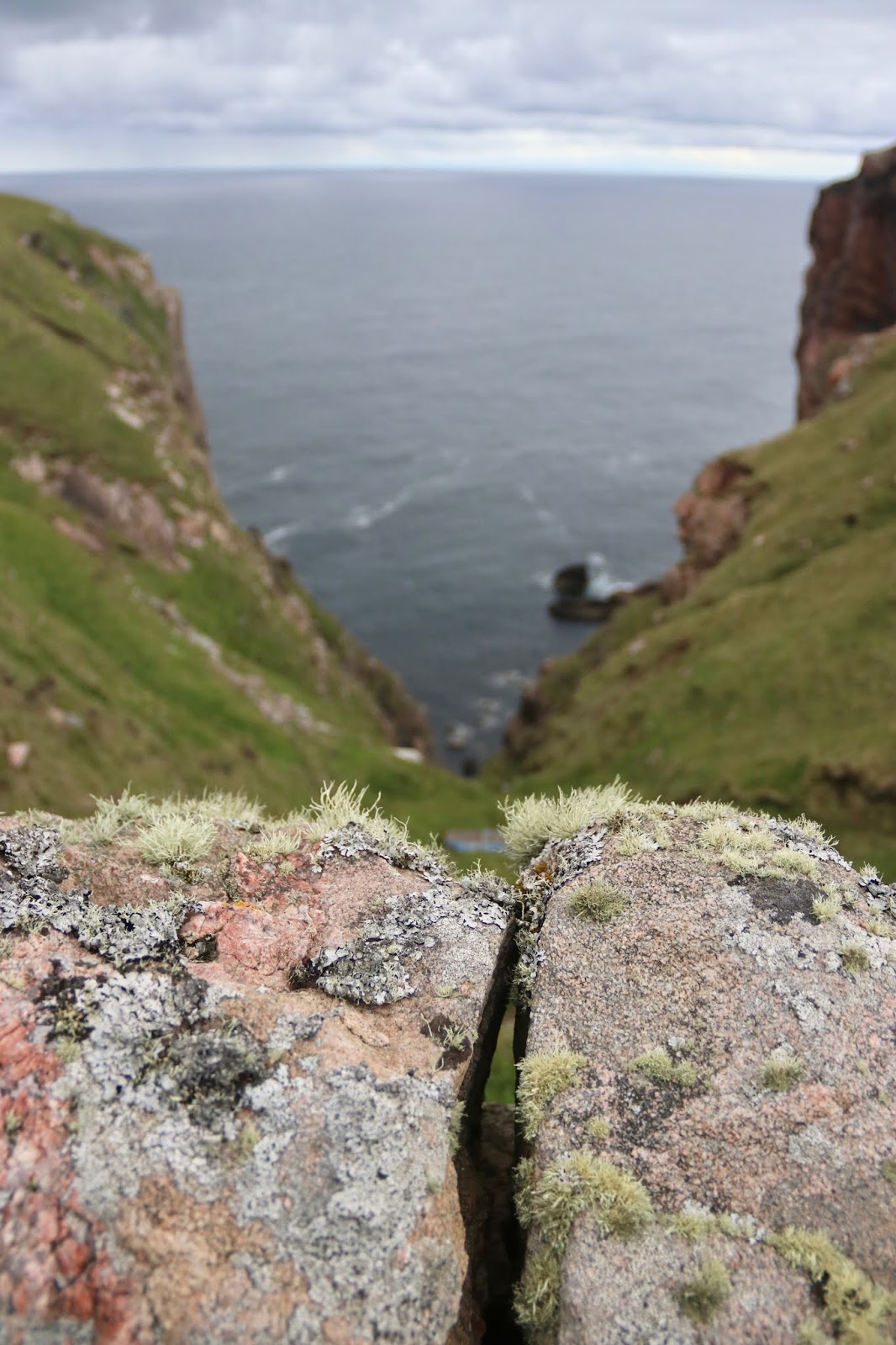
I woke at 4:00 a.m., which wasn't hard to do, since I'd gone to bed early and because the days are so long at this latitude that I first saw daylight around 3 a.m. My goal was to walk to the Cape Wrath Lighthouse before 2 p.m., so I could get a lift on a tourist bus that takes people to the ferry at the Kyle of Durness. I surprised myself with how swiftly I moved, climbing over a couple of mountain passes, and completing ten miles of entirely wild walking by 10 a.m. (It helped that I was no longer hauling 8-10 lbs of food.) 

It was a surprise and joy to finally see the lighthouse, which had just gotten a fresh coating of paint. The lighthouse is an arbitrary end point to the unofficial trail, but having some monument at the end of a long walk provides a sense of closure, much the same way the high peak of Mount Katahdin ably serves as the end point (or beginning) of the Appalachian Trail. This northwest point of Scotland has been called "Am Parbh," derived from Norse meaning "turning point," because this was the point where Nordic ships would turn east to head home. I caught my lift, followed by a ferry, a bus ride, and a train ride back to Edinburgh. 


Cape Wrath Lighthouse

Cape Wrath Lighthouse, with a fresh coating of paint


Feeling rejuvenated, on the ferry over the Kyle of Durness