Sunday, August 21, 2011

Warning: If you major in English, you may just end up washing dishes in a working camp on the arctic coast


So, I’m a working man again. I just finished my first forty-hour week (of menial labor) in over five years.

At Deadhorse Camp (which is one of several camp/motel facilities in the greater Deadhorse area), we have about 30-50 oilfield employees who, for three weeks at a time, live here and work twelve hours a day. We house them, serve them food at breakfast and dinner buffets, and make them sack lunches. (No need to point out the hypocrisy of a raving environmentalist indirectly abetting the initiatives of the oil industry.)

I am one of five people who work here (three of whom are permanents). And while I’m not one of the permanents, if you include me in the five, then sixty percent of the Deadhorse Camp workforce has a college degree in English—a degree that has clearly served no purpose in preparing us for the duties of our jobs, but does, however, empower us to have impassioned 45-minute conversations on whether the film Scream does or does not fit within the horror genre. (Self-deprecation aside, I do and always will cherish my impractical degrees.)

I’ve been spending about six hours a day in the kitchen, every day of the week. I scrub the bottoms of burnt soup pots with wire brushes, dip my hand into sink drains to pluck out palmfuls of slippery vegetables, and cram heavy black industrial trash bags into polar bear-proof dumpsters. I set up the salad bar, slice the bread, arrange the dessert rack, and fold used cardboard.

Apart from the hikes I’ve gone on over the course of the summer, it’s been awhile since I’ve had to be in a continuous state of movement for hours on end. By the end of my first shift, I was physically exhausted, with sore feet and an aching back—and duly embarrassed because everyone around me had been working twice as long. Now—after a week—my back and feet have adjusted and I am in full-out, body-on, brain-off, work mode.

The job, more than anything, makes me reflect on my many previous menial jobs. Over the years, I've mowed lawns, sharpened skates, flipped burgers, scrubbed toilets, delivered papers, cashed a register, and pushed carts. While it is in fashion to glorify some of these blue collar trades, I have no issue unequivocally stating that I hated all these jobs and admitting that I hate work in general. And I realize that—as an American—such an admission is just about as blasphemous as doubting the existence of Jesus as our savior, but there’s no way around it: I hate work and I’ll do most anything to avoid it, short of taking unemployment checks. And when I mean “work,” I mean working for somebody else, punching a clock, at a job that isn’t entirely of your choosing, at a place or company you’re not exactly free to leave whenever you want. I don’t consider tutoring kids work, or building David a stone path work, or writing my book work—largely because of the loose, unstructured, independent nature of those “jobs.”

Mostly, I hate how the hours go by, how the days melt into one another, and how you realize, suddenly, just how many weeks, months, and years have passed—with the great majority of them devoted to giving someone else your time and spending what few hours you have of your own recuperating from the exhausting toil.

After dishwashing, by the end of the day, I have no ambition to do anything. I have little desire to write, or self-improve, or do anything constructive. All my instincts tell me to lie down, drink cheap beer, and watch another episode of “The Wire.” (In the week I’ve been here, my coworkers and I have exhausted our supply of booze and watched the first 13-episode season of “The Wire,” which, by the way, is one of the greatest TV shows I’ve ever seen.) And while there's nothing wrong with resting after a day's work in front of the tube, a man can't help but question his purpose in life when he spends his time doing something of very little consequence for just a little bit of money.

I know I’ve only been doing this for a week, but there’s nothing like washing one individual spoon after another, for half an hour, in the middle of the night, in a silent kitchen, at a working camp 300 miles north of the Arctic Circle, that makes you think about the direction your life is headed in.

My prevailing thought: What the fuck am I doing washing dishes up in Deadhorse?

This question takes on added significance when I consider a recent job opportunity I turned down. Right around the time I got my degree from Duke, an EiC of a respectable magazine strongly encouraged that I apply for a writing job that offered a yearly salary in the high 30’s. I was tempted. But only for a moment. The catch was, if I took the job, I had to stay there for at least three years.

But if I took it, I would be able to do what I love most (writing), I would have a respectable job that puts me on a track to a respectable career, and I would make plenty of money I could put away for a rainy day, as well as the other standard perks: health insurance, dental, 401k….

Ultimately, I turned it down because I didn’t want to be stuck somewhere for three years, sitting at a desk for much of that time, writing articles about things I’m not entirely interested in… I thought I’d be missing out on other challenges, glories, and wonders if I sentenced myself to three years of obligation. In other words, I sacrificed financial security for freedom.

But freedom to do what? I’m effin’ broke and I still have no idea if the book is really going to happen. I currently have $2,000 in the bank, $400 in my wallet, and about $1K in checks that I’ve yet to cash. Freedom to wash dishes?

I suppose, while washing spoons that night, I wondered, for the first time, if I made the wrong decision. I wondered if I’d become too rigid, too unrealistic, too dogmatic. I wondered if maybe I ought to start making more “responsible” decisions. Maybe I should have taken the writing job. Maybe I should have been a park ranger again, making twice as much money doing fun, worthwhile stuff…

But then I reminded myself how lifestyles are traps—traps that are incredibly difficult to escape from. Once you get a career, you get things, you get money, you build around you the infrastructure to have a family. And then—now that it’s convenient—you get a family. And ten years later, you find yourself stuck—stuck in a career you can’t afford to give up, stuck in a family you can’t morally extricate yourself from, stuck inside a personality that is one-dimensional. I think I’ll be happy to be stuck someday, but not now.

What I want more than anything is to write and to continue to experiment with life, which a career very much inhibits. I guess I sometimes forget what I want; I lose sight of the path I put myself on. So I guess it’s good to do what you hate once in a while. When you're most constrained and least inspired, dreams are resuscitated from the dead, empty souls glow to life like blood pumped back into slumbering limbs, and the comatose are shaken awake with a swift kick to the groin.


Mopping the kitchen.


I make about 25 lunches a night. You got me what this lady wanted.


Drinking beer with fellow coworkers after my shift. They were eager, to say the least, to get their paws on the Pabst, as they'd been subjected to Genesee before I came up.

Monday, August 15, 2011

Deadhorse, my new home


Whenever I'd tell one of my Coldfoot coworkers that I was heading up to Deadhorse for a couple of weeks, their first response was maniacal laughter followed by--when they observed my steely glare and were reminded of their imprudence--heartfelt expressions of earnest sympathy. Because of its distance from the mountains, civilization, and the female gender, Deadhorse is generally looked upon as a step down from the comforts and conveniences of Coldfoot.

"Deadhorse is like someone took a shit and forgot to flush," one of them opined.

Two nights ago, I drove a van full of linens up to Deadhorse, where I'll be living for the next couple weeks. As I've mentioned in a previous post, one of the workers up here quit, so the manager (who also runs Coldfoot Camp) needed a guy to fill in to clean rooms and wash dishes.

The Dalton Highway, at these latitudes, can be quite rough. In certain sections, the road is like a washboard, with parallel grooved lines every foot apart that rattle the van so much you can't help but drive the rest of the way with a headache and a grossly uncomfortable erection. When I advanced north through the Brooks Mountain Range and onto the flat coastal plain, I watched, terrified, as the clouds moved in an east-to-west, end-of-times fashion. The pinkish-red storm clouds seemed to blow across the sky just feet above the van, moving at blistering, unearthly tornado-like speeds, which just looked so, so, very, very weird because everything on the ground remained perfectly still (probably because there's nothing on the ground but rocks, low shrubs, and six-inch hight cotton grass). "This place is just weird," said Steve, another coworker from Coldfoot who drove up with me. My thoughts exactly.

Here's my new home. This unit was just brought in, as were several more, so they could house the employees up here who work in the Prudhoe Bay oilfields, as well as the few tourists who come up here and need a place to stay.


Here's the inside of my room. The heater unleashes odors of sauteed battery acid, and the room smells of nicotine and formaldehyde. I actually don't know what formaldehyde smells like, but it has has that chemically sterile flesh-burning odor to it, which the word brings to mind. (Note: The guest rooms at Deadhorse are actually quite nice, so, noble traveler, please don't let my hardly-objective descriptions stop you from visiting.)


The camp manager offered me two rooms. With the first, the view offered nothing more than a wall of orange aluminum siding. But with the unit I chose (to which he refers, hopefully, as my "writing studio"), I can see a bit of the landscape. The Dalton Highway--which you can't quite see--is just a stone's throw from my place. Everything up here in the coastal plain is so flat and there are so few geographic features, the view in all directions appear to be the same.

"Is that the ocean?" I asked while looking out my window to one of my coworkers.

"Ken, that's east," she said.

"Oh."


In ways, the room is a step up from my cabin in Coldfoot. I have electricity, heat, a closet, and I now have, amazingly, a stable internet connection permitting me access to YouTube and Pandora for the first time in months, which are modern conveniences that I have "done without" just fine, but they are warmly re-embraced nonetheless.

This carbon monoxide detector chirped anxiously every few seconds. Because I figured it was a greater risk to my sanity than the monoxide was to my health, I dismantled it.


After feeling grimy from the long drive, I took a shower yesterday evening. (Coworkers share the communal shower with the tourists and pipeline workers.) The water here, I've been told, costs 35 cents a gallon. So it's no surprise that the water leaves the shower nozzle at an exasperating dribble; the pressure being so slight, I must stand directly beneath it. Whenever I turned to wash a different part of my body, I'd accidently nudge the hot-cold dial, which, for whatever reason, is hyper-sensitive, so much that a millimeter adjustment to the right or left would send boiled, skin-melting water onto my shoulders, or a polar, heart-stopping frosty slush.


Some more views. Here's Deadhorse Camp, where I'll be working.


Bleakness.


It seems that my homes are getting gradually smaller and smaller in weirder and weirder places. But maybe it's just that sometimes progress points in funny directions.

Saturday, August 13, 2011

Oh god, I'm going to Deadhorse

(Deadhorse Camp is the yellow building on the right)

Tomorrow, I'm heading up to Deadhorse, a greasy, steely working camp near the oil fields and Arctic Ocean, for a couple weeks. The guy who runs both Coldfoot Camp and Deadhorse Camp is short on a cleaner/dishwasher up there because someone recently quit.

Because I'm the only person in Coldfoot who's technically unemployed, and because I want to do him a favor for providing me with room and board this summer, but also because I'm eager to put away a little cash, I agreed to fill in.

So tonight I'll pack my bags: clothes, computer and a 12-pack of Pabst (surely not enough to get me through two weeks, but I'm not going in unarmed), and tomorrow morning, I take off.

Monday, August 8, 2011

Working in the arctic


It's starting to get cold up here. Summer is turning to fall, green to red, rain to snow. Because I don't have any source of heat in my cabin, I've been having to wear a set of thermal underwear, as well as a coat and hat while I write. Lately I've been able to see my breath.

It was my original agreement with Coldfoot Camp that I'd work one day a week (for free) to cover my room and boards costs, and I'd spend the rest of my time writing. While we faithfully kept to that agreement for the first month, things have changed lately, now that business, here, has picked up. So, for the past several weeks, I've been working about 20 hours a week--all on the clock--for $11/hour. And it's been great.

I've learned that writing is not the greatest full-time job. It's a lot of fun to write every day, but I tire of sitting on my ass. Plus, the muse is fleeting when you continually harass her for inspiration. Working a part-time job and making a little extra cash has been an unexpected benefit of my life up here, plus I don't feel like such a free-loader because I'm no longer sitting in my cabin all day while everyone else around here does what is commonly regarded as "real work."

Here I am roto-tilling two large rectangles of ground. Coldfoot Camp is powered by diesel, and about a half-decade ago there was a 4,000 gallon spill. That dirt was removed to a special location. And here, once a year, it's roto-tilled so the diesel that has drained to the bottom can evaporate in the sun.


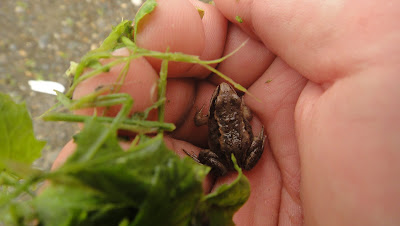
I found this frog in the unlikeliest of places: the diesel pond. A striking find because this is my first sighting of an amphibian in the arctic.


I've also done a good deal of tour guiding (which I did up here full-time five years ago when I was paying off my debt). Typically, I'm either oaring a raft down the Koyukuk River or driving tourists up to Wiseman (a semi-subsistence village fifteen miles north of Coldfoot) where the tourists get to meet hunter and trapper, Jack Reakoff, who's lived in rural Alaska all his life. I give them a broad overview of the region's history, plants and animals; Jack tells them everything about Wiseman and subsistence living.

Here I am, guiding.


Jack talking to tourists by his home in Wiseman.


Jack with moose and caribou hooves.


Jack showing tourists the inside of his cabin.


Jack's cabin.


The northernmost garden in Alaska.


Princess and Holland America buses do tours up and down the Dalton Highway, from Fairbanks to Deadhorse, which is just a few miles south of the Prudhoe Bay oil fields and the Arctic Ocean. I have a love/hate relationship with the tourists. They're all so kind and nice and grandmotherly, yet I'm constantly appalled with their poor health, and I--in general--frown upon their overly structured way of living/traveling. But still, I like them.

A few weeks ago, one of the Princess buses broke down 30 miles north of Coldfoot, and 220 miles from their destination, Deadhorse. Because all the guides here in Coldfoot were busy, I got to drive them all the way up in one of Coldfoot's tour vans to Deadhorse--easily the worst place man has ever created.

("A" is Coldfoot; "B" is Deadhorse.)


This is what the road looks like north of the Brooks Range when it turns to flat tundra.


And here's Deadhorse, near the arctic ocean, which is working camp that houses all the oil field workers. It is a cold, steely, metallic industrial town with guys outnumbering girls at least 15 to 1--a ratio I created based on my own observations. And while this number may seem intriguingly favorable to some of my female readers, I beg you to beware of the common Alaskan adage that holds true all along the Dalton Highway: "The odds are good, but the goods are odd." In Deadhorse, there are no schools, no churches, no libraries. There's nothing really, except for lots of oil, dudes, and metal. I feel like the joke needs some punch line, but Deadhorse is no joke. It's the sort of place you go if you want to descend into a Shining-like mania; the sort of place where you'll find your roommate hanging from the ceiling with the elastic of his underwear ringed around his neck.

Some views of town.


I drove back to Coldfoot the same night--literally a 500 mile trip in a day. Here are some pics of the sun hovering above the horizon at midnight.


Lastly, some weird/dumb things tourists have said... I've spent much of my time at Coldfoot dealing with tourists as both a tour guide and park ranger in the visitor center (also located in Coldfoot). Recently, I got hold of a document containing a secret list of quotes, which I share for your amusement.

“Where do they put them at night?” –woman from NY asking about what animals she might see and someone mentioning a musk ox.

“Do you drive back to Fairbanks every night?” (Fairbanks is 250 miles away.)

“Do you have any sort of 7-11 up here?”

“When do the caribou turn into moose?”

“Do you sell condoms here?” (not a stupid question, I guess)

“This is the United States. A places like that should not exist.” (Woman referring to the lodgings at Coldfoot Camp. She refused to shower there and desired to sleep in the bathroom at the ranger station across the road.)

“I was wondering if bears are attracted to blood and if so, should I be worried about this cut?” –girl from NYC

“So how do I go about applying for religious objection for paying to go into the park?” (There is no fee to enter the park.)

A couple asked a tour guide if they were still offering dog-mushing tours for $79. (It was summer and there was no snow on the ground.)

“Is there a dotted line marking the location of the Arctic Circle?”

“I have heard that watermelon berries have a laxative effect. Is that true?” –Older man

“Is that the sun or the moon?” asked looking up at crescent shape in a dark sky.

“This is a snowy owl,” someone said, looking at a ptarmigan

“Where am I??! THEY NEVER TELL ME WHERE I AM!” said an old lady, while threateningly pursuing a guide with her cane

“We’ve just come down from Deadfoot!” (probably referring to Deadhorse)

“Are the northern lights running now?”

“I’m not sure if I want to go to Deadwood.” (again, probably referring to Deadhorse)

“Today we came up from… somewhere.”

“Is this all there is to Fairbanks?” (woman upon waking up in Coldfoot after a long drive.)

“Don’t do drugs. This is what you’ll look like.” (Framing her face with her hands)

“Wolf-colored” (Lady’s response to a question about what the color of the wolf was that she saw.)

“Is there any water at Galbraith Lake?”

“Good morning.” (It was 6:30 p.m.)

“Can we stamp our US passport?”

“It’s like a Stephan King novel” (referring to Coldfoot)

“Will there be other people at the campground? We don’t want to be alone.”

“I need some help here… this stamp pad is completely dry.” (The pad was closed)

“Can I have an Arctic Circle certificate for my cat?”

“How do the animals know when to sleep?”

“Well, you’ll have to tell me where your glory holes are then.”

“How far is Horse-dead?”

Sunday, August 7, 2011

My first paid article: A story on Duke's new campus farm

(Photo Credit: Megan Morr / Duke Magazine)

A few months ago, I wrote an article about Duke's new campus farm. It just printed in Duke Magazine. You can read it here.

This occasion makes me want to discuss two things: my paid writing "career" and campus farms.

1. Paid writing

I've been writing semi-professionally since 2004. It all started when I became a writer, and later, an editor, for the Arts & Life section of my undergraduate school's student newspaper. In the years before I started this blog, I wrote a couple freelance articles for Buffalo's alternative weekly newspaper (Artvoice) as well as a guest op-ed column for The Buffalo News. (I'm exceedingly embarrassed about most of my work back then, so I won't be going out of my way to share any of those articles.) Anyway... during the past seven years, I estimate that I've made a mere $1,800 for my words.

This article marks this first time I've been fairly paid by a publication. And goddamn, it feels good. Between this article and another that will print in their next issue, I received a check for $1,200. I guess it's my goal--and my main purpose of being up here writing in Alaska--to make a living with my words. While this goal seems as impossible as ever and this check is by no means enough to permit me to live in anything more than a van (or as a freeloader up in Northern AK), I guess it's a step in the right direction.

2. Campus farms

I absolutely love the idea of a campus farm. The great thing about Duke's new farm is that it's not only run by students, but all the food produced on it is sold to the food company that runs various dining halls at Duke. In other words, students produce the food, then eat the food.

More and more, I think colleges should encourage, if not enforce, their students to receive a practical education to complement their classroom-based liberal arts educations. Don't get me wrong: I do not think college should be a place where you go only to obtain "career skills." That's not what I'm talking about at all... Rather, I think college should be a place where we go to become the most well-rounded, cultured, and complete persons we can be. It should help us become full-fledged human beings.

College does not do this... By the time we graduate, we've spent much of the last 16 years of our lives sitting in front of desks, sitting in front a computers, or sitting at boring on-campus jobs. Not only do we have almost no practical skills, but we've focused our studies on some minute subject; "Biomedical engineering" or "Parks, recreation, and leisure studies," for instance. We become specialists: great at one thing, and useless at everything else.

So what's a graduate to do who can neither land a job, nor has any useful skills to help her take care of herself? I don't know the solution, but here's a wild idea: colleges include a requirement to take x number of "Self-Sustainability" courses during the course of a student's undergraduate education. It would be a hands-on, dirt-under-your-fingernails education. Some examples of such courses:

"Tending an orchard"-- In a semester, you'll learn about planting an orchard, maintaining the trees, canning, preserving, etc.

"Farming"--You'll learn how to till the soil, plant, irrigate, etc.

"Construction"--framing walls, the basics of masonry, roofing, etc.

There could be semester-long courses on carpentry, cattle farming, electronics, plumbing, car maintenance. But only the basics of surviving on your own; nothing too narrow or esoteric (i.e. basket weaving). No one will leave such a course an expert, but the student will no doubt feel at least somewhat comfortable with a skill she'd be reasonably familiar with.

I think 2-4 such courses over the course of one's education would help produce graduates that are on their way to becoming free-thinking, self-sufficient citizens. Crazy? Insane? Any thoughts?

Anyway, campus farms are a step in the right direction. It provides such an arena for students to receive practical educations.