Saturday, October 15, 2011

A tour of Coldfoot


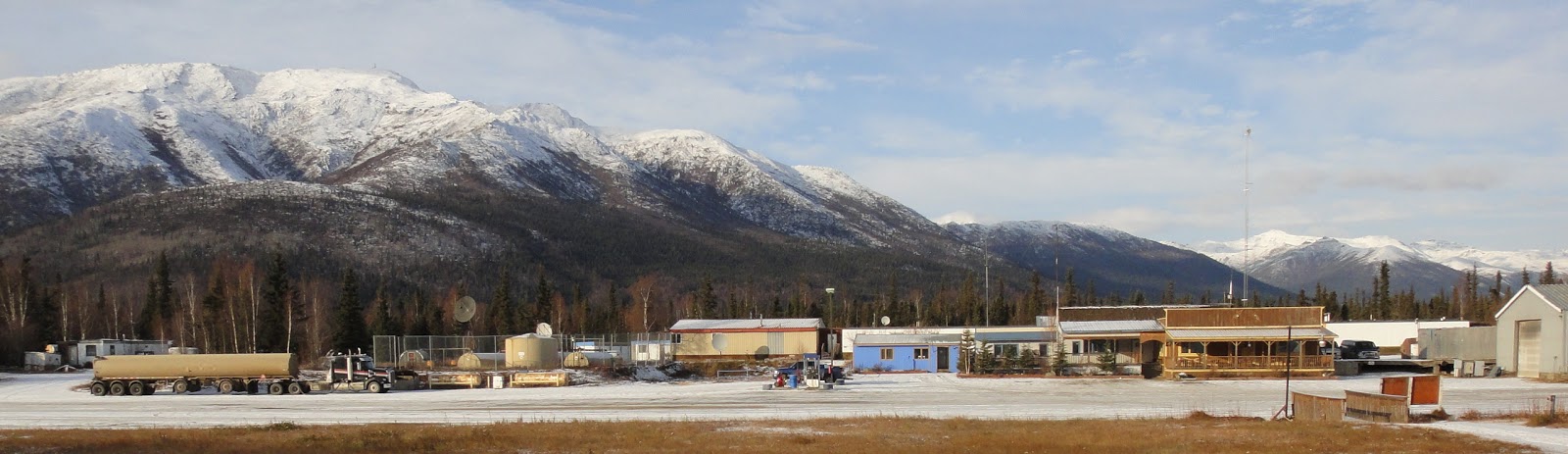
After spending a week and a half in Ferry, I hitchhiked up to Fairbanks and guided a van tour up to Coldfoot. I've been here since. Because I'll be leaving Alaska in a couple days, I thought I'd do a picture tour.

Coldfoot, in 1898, was first a "boom town" during the Alaskan gold rush. It was soon after deserted, but became home to several hundred workers in the mid-70s, during the construction of the pipeline. It was deserted again until Dick Mackey, a famous dog musher, came up here to serve burgers out of a blue school bus. The truckers--desiring something more--dropped off their empty packing crates and built this cafe.


Coldfoot serves truckers and travelers who travel up the Dalton Highway--a 416-mile half-gravel, half-asphalt road that's become popular on the reality TV show "Ice Road Truckers." Coldfoot is in the middle of  the Central Brooks Range, and the mountains we see in the pictures are between 3,000 and 4,500 feet tall.

Here's the "Truckers Only" table. Fox News on the telly as usual.


The "Frozen Foot" saloon.


Here's Sassy, who lives in and around the cafe. 


Here's the 52-room, Slate Creek Inn, also owned by the people who run the cafe. This building was refurbished from one of the original pipeline dormitories.


There are about 20 or so dogs in camp (outnumbering the winter population of people). They're mostly Alaskan Huskies. They'll be mushed throughout the winter. 


Incinerator.


There are lots of old equipment, vehicles and buildings behind Coldfoot.


The Diesel generator, plus some ravens hanging out by the dump. Most of the garbage is shipped to a dump in Fairbanks.


The "Tire Shop." There are lots of blown tires on the Dalton Highway.

Sunday, October 9, 2011

Ferry


After hitchhiking 600 miles and thirteen hours with a sheet metal worker from Deadhorse (who was en route to Wasilla down south), I was dropped off in the middle of the night in Ferry, Alaska—which is not so much a town, or a village, but a scattering of cabin-esque homesteads about 100 miles south of Fairbanks near the northeastern corner of Denali National Park.

Where I was going mattered little. I was running from work and chasing after someone. This someone had traveled to Ferry to visit with friends—a family of four living a mostly subsistent lifestyle in the woods. Within driving distance of town, they have some modern amenities like electricty, internet, and cell phone service, but for the most part it's a DIY lifestyle: growing vegetables, chopping wood, making jams from berries, and hunting animals for meat. I’d spend the next ten days with these strangers.

I stayed in their Arctic Oven, which is a 7-foot-tall, 9-foot-sided tent. It's ideal for cold weather habitation and costs in the vicinity of $1,500. It comes with a wood stove that connects to a pipe that pops out of the roof. Outside, the temperature ranged from 25-40 degrees, but inside, when the fire was going, it was a comfortable 80 degrees.


I was eager to take part and learn about the daily tasks of their lives. Here I am separating leaves from a pot of blueberries. The blueberries would made into jams and syrups, which they'll use for the rest of the winter.


Tyler and Erin getting the jars ready. (Erin doesn't like having her picture taken; Tyler doesn't mind.)


A friend, with excess meat, gave them the front quarter of a bear.


Taking my first stab at butchering.


Plain bear meat to be served over rice. Not bad at all.


Tyler, Mowat, and me, repairing a neighbor's floor.


Koa in the greenhouse where tomatoes are growing.


Ferry funny farm: cabbage, snap peas, arugula, corn, lettuce, snap peas, beets, carrots, etc. etc. They also have honey bees.


Hauling fallen wood out on ATVs.


The Ferry cemetery.


Trying to get writing done, but Romeo made it tough with his constant pleas for affection. He would often grab my hand with his paw as if to tell me I should be using it to lavish him with caresses.


Son, Mowat, 7, unearthing a carrot.


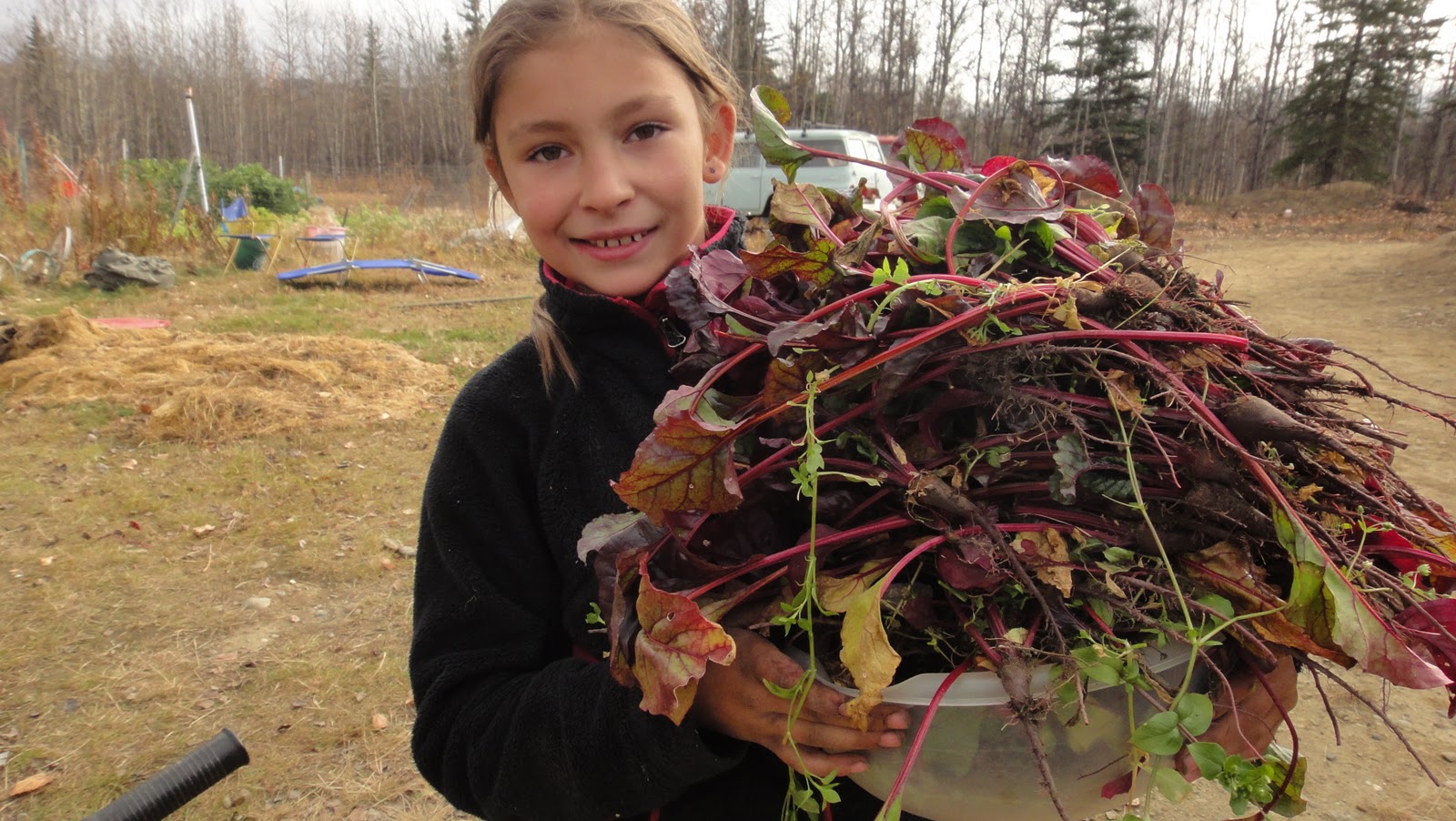
Daughter, Koa, 10, harvesting beets.


Picking cranberries.


The geese were heading south.


Drinking from stream. They will haul large plastic canisters from the spring to the house.


Boot Hill. People commemorate lost loved ones up here.


Not sure exactly what the story of this plane is, but I'm told it was put here on Boot Hill, and didn't land in this fashion. That's the Alaska Range in the background.


In their cabin, there’s no shower, no flush toilet. Baths are infrequent, and visits to the Laundromat in Healy, even more so. There’s no home workout gym, no wine rack, no jewel-toned vases, no liquid-screen television (or whatever they’re called now).

It’s the sort of home where kids and dogs (and chickens, in a previous year) run wild. There’s clutter. There’s mess. But their home—absent the trappings of the modern McMansion—is full of a soulfulness, a kindness, and a warmth that is characteristic of homes whose inhabitants are tightly-knit as a family, a community, and with the environment of which they're a part.

In the morning, I heard, then spotted, a sky scribed with V’s of geese pointing south, honking loquaciously. At night there was the trembling of a hot stove stuffed with spruce logs, then the high-pitched howls of coyotes. For breakfast, blueberry jam spread over homemade bread. And everywhere was the fall forest—a congregation of gnarled green spruce and leafless, bleach-boned birch: the latter of which form a grove of skeletons that will remain numb and bald and bitter until spring.

In such moments, I experienced the rare instance of recognizing that the “now”—the present moment—was going to be a memory that I'd always carry with me. And it would be the sort of memory whose warm glow will always beckon you back, but might be tarnished if you go back and you or it has changed in the interim.

While I’ve lived in Alaska for many years, I’ve mostly resided in dorm-like housing units at Coldfoot, or in lavish government homes when working for the Park Service. My experiences with living a frontier-esque lifestyle have been few.

And while I experienced the discomfort of bathing in ice-cold rainwater, and while it was tedious to keep the stove in the Arctic Oven full of wood, I don’t know if I’ve ever felt a greater sense of belonging in a lifestyle or more at ease with myself. It's the sort of place that'll wash away one's neuroses and self-consciousness; the sort of place where it's impossible to care about the existence of unsightly shoulder hairs.

How rare and refreshing it is to come across a home so absent of pointless decorum and so full of soul. And I can't help but think the absence of the one fosters the presence of the other. It seems as if—in all the time we devote to disinfecting our homes to kill some one-in-a-billion germ that might cause our innards to grumble for but a few hours—we pollute what should be a carefree, easygoing atmosphere. It is a toxic obsessiveness. Cleaning—for the sole purpose of cleaning—creates a culture of stuffiness and resentment. Aren't our bones and skin and hair borne of the soil? Why must we be so squeamish of a little dirt?

Upon heading back up north, I thought of an Inuit word the Eskimos have called "Koviashuvik." They use it to describe “a time and place of joy in the present moment.” And while Koviashuvik is—by its very definition—fleeting, I couldn't help but think that maybe there are ways and lifestyles and people that could make it last. 

Wednesday, October 5, 2011

How a piña colada almost killed me

Two weeks ago, I was on my hands and knees on the floor of Deadhorse Camp’s “coworker lounge,” trying to cough, or breath, or do so something, anything, with my lungs. But I couldn’t do anything except pound my chest and look at my friends with wide, frantic eyes. I was choking to death.

Moments before, I’d been drinking my third piña colada of the night. I was still wearing my red and black kitchen uniform because I’d just finished my evening dish shift. I had a friend bring up my bottle of rum that was in my room in Coldfoot, so we celebrated by making piña coladas.

I was in a jolly mood, and after Liam told me about his absurd but amusing idea to start a “munchies catering business” (in which he drives to parties to serve munchies to drunks, crafting the meals out of whatever’s in their pantry and fridge), I started laughing uncontrollably. The piña colada, which had some ice cream mixed in, started to come up and out of my nose. But because it was thick with ice cream, the drink didn’t gush out of my nose like it should have; instead, it just clogged my upper respiratory area.

I coughed for a few seconds, and when my lungs could no longer take in air, I dropped to my knees, holding my throat. At first, Liam and Emma (the only members of the get together), looked away. Liam thought I was throwing up, so he respectfully turned his head. Emma got up and stood over me, slightly more concerned. Seconds later, I was pounding my chest, signaling them to give me the Heimlich. But they were in a state of shock. Liam could only gently pat my back, and Emma, forgetting how to give the Heimlich, set up a chair, so I could give it to myself.

“What should we do?” Liam asked.

“I don’t know. I don’t know,” said Emma.

With Jimmy Buffet’s “Margaritaville” (or some such song) streaming on YouTube on my computer, I realized that I was running out of air and that I wouldn't be able to last much longer. This could be it for me. Yet even amidst the panic, I took a moment to feel embarrassed. Here I am choking to death, in my dishwashing outfit, sprawled across the floor, just halfway through my third drink.

I am being killed by a piña colada…. Give me a bear, starvation, a mountain cliff, some worthy cause… Anything other than this! If I’m going to go, let me at least go in respectable fashion. Oh, how un-literary a death.

And then, all of a sudden, I coughed up the thick drink that had been lodged in my throat into the plastic cup beneath me. I got up, coughed some more, sat back down on the couch, and tried to laugh it off. The party ended soon after.

***

I had disturbing dreams that night. I dreamt that I had been fasting. And after fasting for a couple days, I wanted to wow everybody and fast some more. I gradually withered away, turning into a bag of bones. In my dream, I remember thinking that there was something beautiful about dying this way.

I awoke in the late morning with a scratchy throat and a slight hangover. I thought about the dream and remembered how Liam had once described to me Kafka’s short story, “A Hunger Artist.” I walked out of my room, out of camp, and towards the Sag River, the wind bludgeoning me in the face with 20 mph gusts.

I was hoping to be struck by some epiphany, some lightning bolt; to be given some message about where to go and what to do with my life. Maybe I should just keep walking. Maybe I should pack my bags and put my thumb out and head south.

But the epiphany never came. I just thought about this place; this barren coastal plain. I thought about how this place reminds me of the film Black Narcissus—set in the Himalayas, where some well-meaning nuns try to turn an old palace into a school. They never could, though. The palace will always be a palace—a place for kings and queens, ornaments and jewels and delicacies. The wind from the mountains drove the nuns mad. It never stopped. It moved into their rooms, invading, molesting, reminding them, like a ghost, that this place is and only will be a palace, and that you can either accept that and change or die trying to change it.

That’s how I feel here. Like we shouldn’t be here—that this place is meant to be still and silent and unbothered. I looked north at the facilities, the giant drills, the mud-spattered cars. It’s like we’ve planted a big ugly town on some sacred site, some ancient burial ground. There just seems to be something wrong about our presence here, like a cathedral on the edge of a volcano, a log cabin on a city corner, an industrial work camp on the deathly still coastal plain. We don’t belong up here, at least not this way, I thought. A place like this could drive a man mad.

That evening, I went back to the kitchen for my dish shift. I felt like I was a character in a story, but a poor, unassertive character in a story without a proper conclusion. Shouldn’t this be a turning point? Shouldn’t this be where I change shit around, when I change and grow, when I get the hell out of here? Instead, I just put out the salad bar and washed my spoons.

We are, by nature, impressed with stories and symbols. Our lives are our stories, made up of events and people and things to which we assign symbolic meaning. And when we step outside our stories, I think it’s then that we feel most lost; when we feel like we’re losing the grip on our identity.

A couple days later, two Deadhorse Camp coworkers came back from their vacation in Japan. I packed my bags, put on my rain suit, and set out in the blistering misty gales, under a bleak storm scorched sky.

There was nothing grand or literary about my departure, but once I got on the Dalton and set my pack down and held out my cardboard sign to south, I was excited about the prospect of turning to a new chapter.


I got a ride with this sheet metal worker. He took me 600 miles to the south.

Monday, September 12, 2011

Escape from Prudhoe Bay


“It sounds like your inner Odysseus is lost at sea,” said Liam, the prize chef of Deadhorse Camp.

I’d just let out a sigh—a desperate, pleading, “kill-me-now” sigh—for the third time in the hour. With a wire brush, I’d been trying to scrub dried specks of mashed potato off the rim of a large metal stirring bowl.

I’d been working the evening “dish shift” almost every night for the past three weeks. And I’d never felt so purposeless. Somehow, over the course of the summer, I’d gone from an inspired and well-meaning “writer in residence,” to tour guide, to dishwasher. It was as if I was on some cruel Scrooge-like, time-traveling tour, visiting my previous jobs, each demanding less skill and responsibility than the previous.

After a while, I no longer felt like a writer, or a vandweller, or some principled Thoreavian; I’d momentarily forgotten "me"; I was now nothing more than a dishwasher. I cursed more. I told crass, tasteless jokes. I wore smelly, stained, soup-splattered shirts. I spent my nights drinking cheap beer, watching TV, and the beginnings of a paunch began to bud out of my belly. Dishwasher. I’d grown my beard out, but not for the usual reasons—facial warmth and aesthetic beauty—rather, my patchy brown scruff was evidence of a rapid degradation of self-worth, which made all established habits of hygiene and physical upkeep seem pointless. I felt bitter and demoralized; an invisible automaton, a dishwasher.

I knew my mental health had become ill when I—upon dropping a tray of turkey lunch meat—didn’t maniacally curse as I normally would in such instances; rather, I just stared at the meat sprawled across the floor silently, my frustration silently approaching the brim of its containment tank, like brown water nearing the rim of a clogged toilet ready to spill over in a deluge of messy, violent anger. I just hope I’m nowhere near the knives when it happens, I thought.

Then Liam said, “We need to get out. We need to packraft the Sag and see the ocean.”

And so we did.

Liam said it would be a five mile hike to the Sag River. We’d packraft north (two or three miles) to the Arctic Ocean, then we’d paddle west across the coast and descend south down another branch of the Sag to Deadhorse.

Sounded like a plan to me.

Donning dry suits and toting light day-packs, we hiked out over the flat, hard, easy-on the feet tundra. The fall foliage was colored with squash yellows, apple reds, and pumpkin oranges. Most of the birds that had been up here had already migrated south, but there were still vestiges of the summer swarms of flying life: we spotted snowy owls, flamboyant loons, floating gulls, flocks of geese, and gaggles of ravens. Off to the north—through Liam’s binoculars—we saw a golden eagle (or some giant bird) on the ground that flapped its wings at a ghostly-white arctic fox obnoxiously running laps around it.

We inflated the packrafts and let the Sag—swift and powerful at these northern latitudes—carry us to the Arctic Ocean. Except the ocean wasn’t a mere couple miles away as Liam thought it was. We’d stayed on the river for three hours, and while we expected to see the ocean after each bend in the river, we never did.

Because of our late start and the longer-than-anticipated time we'd spent on the river, we began to appreciate just how late it was getting and how low on time we were. (We had to be back in camp by tomorrow morning for our kitchen shifts.)

And then, on the river, just ahead, we spotted something white and bulbous. We both pulled over to the bank, quickly and instinctively.

“Do you see that?” I asked Liam.

He took out his binoculars and glassed the object. “I don’t know what it is,” he said, “but it’s big and it’s moving.”

I will openly admit that I have a fear of bears, but the polar bear—the bear I know the least and the bear that is, reputedly, the most fearless of the ursine family—was enough to make me think about showering my eyes with pepper spray, right then and there, just so I didn’t have to watch it come and maul me.

Whatever it was, it wasn’t worth paddling past. We decided to raft to the other bank, deflate the packrafts, and get the hell out of there. As I feverishly deflated the raft and sloppily strapped it to the outside of my pack, my frozen hands and saturated gear coated in rough sand, I watched the polar bear, which actually turned out to be a gull, leisurely float down the Sag passed us.

One’s sight, we learned, can no longer be trusted on this flat, lunar, northern landscape.

Okay, no polar bear, thank god, but we had more than enough problems. For one, because we thought this would be a short day-trip, we didn’t have any overnight gear: no sleeping bags or tents. And because we were so far north, there would be no wood to start a fire. And, after looking at my GPS, I saw that we had a 12-mile hike back to Deadhorse, which would actually be more like 15 when you consider that we would have to walk around ponds, lakes, and tundra bog. And our biggest problem: it was getting late, dark, and foggy, and we had to illegally walk through the vigilantly monitored, hyper-secure Prudhoe Bay oilfield—the largest oilfield in North America that, before drilling started in 1977, held 25 billion barrels of oil. Hiking through the oilfield is strictly prohibited, and while we had no desire to break the rules, there was no way we could get around Prudhoe Bay. We’d have to sneak through.

And then I felt, for the first time in a long time, the pangs of panic. We’d walked a mile west, or where we thought was to the west, but when I looked down and picked up my pack that I'd set down for a moment, I’d forgot from which direction we’d come and to which direction we were heading. I did a 360. And then another 360. Everything was flat. The sky was an overcast gray. Everything looked the same, in every direction. I pulled out my GPS and compass and they each seemed to be as disoriented as I was. Sit down, Ken, and calm down, I told myself.

Eventually a light popped up on the horizon. It was one of the many oilfield facilities, which we knew was to the west. It was the ugly, all-seeing eye that would monitor our impossible jaunt through what felt like Mordor. (After I made this reference to Liam—a fellow Tolkien fan and another overeducated English major—we proceeded to use LotR references to describe our situation, forcing us to periodically acknowledge our nerdiness.)

To stay warm, we walked inside our wind-resistant dry suits. Night supplanted day, and a frosty mist clung to facial hair. On the edge of a lake in front of us sat a giant, bull caribou, bearing a curled crown of skyscraping antlers that were orbited, elliptically, by two bat-like short-eared owls, both of which—after the caribou had regally trotted off and disappeared into the fog—came to inspect us, flaplessly hovering above us like kites.

In front of us was one of many oil camps. It was a small, metallic, rectangular facility with about a dozen outdoor lights. We were all whispers now, wary of being caught and having to deal with the possibility of an interrogation or, at worst, a fine, for trespassing. It was close to midnight and dark, so we thought we could slip by undetected. As we neared the building, we saw some humanoid-like movement. A spotlight clicked on; whoever was manning the light drew figure eights onto the tundra. We stood still, but eventually he trained the spotlight directly on us. We were shocked that he’d spotted us because we were still a good distance away.

“We’re fucked,” I said.

“Just stay still,” Liam said. “If they come near, just lay on the ground.”

“What? I don’t know man. Maybe it would be better if we just gave in if they’ve already caught us.”

We debated what we should do in whispers, remaining perfectly still as the light shone upon us. Because it didn’t appear that they had any plans to capture us and because we thought that there was a possibility that they merely thought we were caribou, we recommenced hiking, each of us lengthening our strides and adding an alarmed briskness to our gait.

We reached an industrial road and placed our footsteps carefully and in sync with one another's to lessen the volume of our boots crunching atop the gravel. We ducked under an oil pipeline and continued on.

Disaster was averted, but we were far from home-free. Ahead of us were several more well-lit facilities that we’d have to get around. We walked next to wells and pipelines and a gravel road—the horizon of Prudhoe Bay was lit up with fool’s progress, a spider web of industry, an Ayn Rand wasteland.

We were close to the next facility, walking parallel with a road. There were lights everywhere, in all directions. White lights, orange lights, red lights, blinking lights, the lights of trucks on the prowl, moving from facility to facility. We couldn't tell which lights were close and which lights were far. And the buzz of machines was ubiquitous. This foreign land never felt so eerie. Here we are, intruders, sneaking through the land of other intruders.

As an augury of ugly things to come, atop a pingo—which is a mound of earth-covered ice—the silhouette of an arctic fox appeared. It howled (which sounded more like a raven's crow), and we nervously strode past it, worried that its cackles would call attention to our location.

We were within a stone’s throw of the facility and the gravel road. I kept an eye on the fox, but when I turned my head south, I saw Liam sprinting away, his arms pumping furiously, piston-like, going as fast as he could over land we couldn’t see beneath us, his packrafting oars rattling with each footfall. I joined him, sprinting across the tundra until I was out of breath. We dove behind another pingo and I asked him why we were running. “You didn’t see it?” he said. “There’s a truck with a spotlight right behind us.”

He was right. On the other side of the pingo, the truck had come to a halt at the end of the road. We could hear its motor rumbling and could see its spotlight oscillating from side to side, its beam causing a white halo to form around the tip of the pingo we sat behind. It was obvious that someone had spotted us at some point. And now they were on the lookout for us. This is it, I thought. All they have to do is get out and look over this pingo. And we’re caught.

But they never did. We continued on through night and fog, around lake and across the other waist-high branch of the Sag.

The trip was a catastrophe; we didn’t make it to the ocean and we ended up back in camp after 3 a.m., prohibiting us from getting a good night's rest before our shifts in the morning.

“This is the best experience I’ve had in a long time,” said Liam.

“I know. Me too.”

***

The Sag. Somewhere to the north was the Arctic Ocean which we never got to see.


Here's packrafting guru and prize chef, Liam (which isn't his real name).


My pack is actually pretty small and light, but looks huge in this picture. (After we got off the Sag neither of us had any feeling in our hands, so I couldn't help but sloppily strap the raft to my pack.)


One of several pipelines we crossed.

The mythic caribou.

Friday, September 2, 2011

How to afford college

Just this afternoon, a couple high schoolers writing for the youth section of an Indianapolis newspaper interviewed me, seeking ideas about how to afford college. Because my mind is on the subject and because the fall semester has just begun, I thought I’d put down, in one post, all my ideas on how to afford college.

The Atlantic has recently reported that The College Board has the average student debt at $27,650, which is far more than the $24,000 total I’ve been using for a while. By the time a freshman today leaves college, it’ll probably be more than $30,000…. So if you’re thinking about leaving school with little-to-no debt, here are a couple ideas that might help.

1. Pick an affordable school.

Too often are we lured to certain schools for the wrong reasons: successful sports teams, lavish accommodations (gyms, climbing walls, elegant dining options), and, worst of all, prestige. Some of these things are, no doubt, nice, but are they worth an extra $20,000 of student debt? While some colleges are better than others, there are great professors everywhere, and oftentimes the best ones are not at your priciest and most prestigious schools. (I’ve had mediocre professors at Duke and stellar ones at SUNY Buffalo.) I don’t think it’s a terrible idea to go to community college for two years and transfer to a state school to finish up your degree.

2. Commute from home.

Room and board for a year at many colleges is around $11,000. Which is just ridiculous. It does not cost $11,000 to house and feed yourself. In my first semester in the van, I lived on $103/week. Over the course of the school year, that’s about $3,700, and that includes EVERY cost in my life—entertainment, transportation, clothes. Every cost but tuition. Let me breakdown how much housing and feeding and transporting yourself costs depending on your style of home...

Living in a dorm: $11,000 / academic year (includes mandatory housing and meal plan)

Living in an apartment: $7,733 / academic year (includes rent [$550 x 10 months=$5,500], food, all vehicle costs).

Living in a van: $2,233 / academic year (includes food and all vehicle costs).

Living with parents: $1,524 / academic year (includes vehicle costs, but not food.)

The above costs only reflect the cost of food, housing, and vehicles (gas, insurance, and repairs). Of course, each of these numbers will get bigger when you factor in cell phone bills, entertainment, clothes, haircuts, etc. And the estimates are by no means perfect because—during my first semester at Duke—I ate very cheaply and drove very little. But the estimates should indicate just about “how low you could go” and highlight just how ludicrous the costs of a dorm/apartment/meal plan are. Over the course of four years, you could pay $44,000 to live in a dorm versus $8,932 in a van or $6,096 in your parents’ home.

3. Manage your finances meticulously.

Find out where your money’s going. Write everything down.

My first semester I kept track of my every cent. I wrote down, in a Microsoft Word file, what I bought, how much I bought it for, and when I bought it. By the mid-point of the semester, I could see how much of my money was going to food, to gas, to insurance… If you watch your money carefully, you’ll quickly see how much of it goes to unnecessary luxuries, and you’ll be enlightened as to which costs are bleeding you dry.


4. Don’t buy crap you don’t need.

We desire things less because we need them and more because other people have them. And we think we can climb to their social status by looking the way they look, acting the way they act, or having what they have. That’s nothing but nasty, weak-kneed conformity. It's what Thorstein Veblen calls "emulative desire." Don’t sacrifice your independence and freedom to fit in with the mass of materialists. Be comfortable as yourself. Be comfortable having a friend cut your hair, buying your clothes at secondhand shops, or cooking noodles and vegetables for $5 instead of going out to eat for $20.

5. Speaking of food, avoid campus dining plans.

Campus dining is a crime. At Duke, it costs as much as $25 a day to eat. A day! That’s highway robbery, and I’m sure it’s just as bad at most other colleges. I ate healthily, deliciously, and abundantly for $4.34 a day. Here’s what it looks like over the course of an academic year:

Duke’s priciest meal plan: $5,500 / academic year

Spaghetti stew meal plan: $1102 / academic year ($4.34 x 254 days)

6. Live in a van.

Live in the woods. Live in a tent. Live in three-foot by six-foot box. I know a girl who lived in a tent and a sailboat at college. I know another girl who lived in a yurt at Duke. I know a guy who lived in a tipi. There are lots of ways to live creatively, boldly, and cheaply that will not only save you—literally—tons of money, but will give you, arguably, a more valuable education than the one you’ll get in the classroom.

7. Realize that you will not get a good, honorable, well-paying job when you leave school.

It is easy to think that you’ll be one of the exceptions, but it’s probably more responsible and realistic to think that you won’t. In 2008, 17.4 million grads with B.A. degrees had jobs that required less than a B.A. degree such as waiting tables, answering phones, and mopping floors. Your starting salary will not be in the high 40’s. More like the high 20’s, or, at best, the low 30’s. Plan accordingly.

8. Maybe don’t go to college at all…

There are a million things we could do after graduating from high school, but it’s been pounded into our heads so much that we don’t consider any option except going to college. It’s a rare opportunity to be young and free and debtless. We can use that freedom to volunteer, travel, hitchhike, hop trains, live in a van, work odd jobs. We can join WWOOF and travel and learn about organic farming. College is great, but there’s a much larger, and far cheaper classroom that we can learn from: the world at large. And if we go out and learn how to camp, how to save, and how to manage our money, by the time we finally enroll in college, we’re probably not going to be so willing to thoughtlessly take out a giant loan and go $50,000 in debt.

9. Get good at saving money

If you’re just leaving high school, you’ve probably yet to have the chance to learn how much it costs to house and feed and transport yourself. Unless you do something extreme, a large chunk of your salary will go to apartment rent, food, and the other basics. Finding jobs that offer room and board are key. Lodges and working camps often offer free room and board, as do AmeriCorps programs. In many cases like these, you won’t need a car. In other words, every dollar you make is a dollar you save. In one year at Coldfoot Camp in Alaska, I made, at $9/hour, $18,000 and saved almost every dime of it. I forgot exactly how I did the math then, but I determined that my saving capacity ($18,000) was equal to the saving capacity of someone making $42,000 in a conventional home-dwelling, car-driving, supermarket-shopping lifestyle. It goes to show that, when you have room and board, getting paid a little can mean saving a lot.

Resources

Coolworks.com — Great website for finding working camp, lodging, etc. jobs.

Americorps.gov — Lots of great opportunities for young people (18 to 24 year olds) to do good, honorable work for a small, though not insignificant, amount of money.

Wwoof.org — World Wild Opportunities on Organic Farms gives travelers a place to eat, sleep and see culture in return for a bit of work.

[PS: If anyone else has any useful tips, please feel free to share in comment section!]