Sunday, August 30, 2009

Rule of Thumb #5: Bring lots of stuff

Day 5: May 19, 2007. Teslin, Yukon Territories to northern border of British Columbia (158 miles).


The two most useful items you can bring on a hitchhike are a baseball cap and a box of Crayola crayons.

The hat serves multiple purposes. For one, it hides bed-head, unruly curls, and tidies up a disheveled appearance that would otherwise keep the hitchhiker on the side of the road for longer than he wishes.

Plus, there’s something very North American about baseball hats. The hat helps the hitchhiker communicate with his prospective driver at 50 miles-an-hour. The driver might think to himself, subconsciously, “He can’t be too bad.”

The crayons are even more important. For one, crayons don’t run out of ink at inopportune times. Plus, the trails of colored wax stick and glide easily onto cardboard signs. Any experienced hitchhiker can attest the practical and aesthetic benefits of crayons. Hobos begging for change and kidnappers writing ransom notes can get away with black markers. Not hitchhikers. The hitchhiker is better off with a set of cheery, family-friendly crayons that explode off the cardboard sign and boldly, colorfully, say, “Pick me up, please! I’m no psychopath!”

Sometimes I’d draw a yellow sun or a forest of green pine trees. When I was trying to get from Alaska to Canada, I sketched a big red maple leaf on a flattened piece of cardboard that once housed bags of frozen french-fries.

Today I was in the native village of Teslin in the Yukon Territories of Canada trying to head to Watson Lake, 250 kilometers to the east. I drew Watson Lake in big, purple bubble letters inside of a giant lake that I shaded with Blizzard-Blue.

But today neither my hat nor my crayons would be of any service to me. I patiently waited for drivers on the top of a hill on the Alcan Highway for 12 hours. But none stopped.

The previous night was one of the strangest and scariest of my life. Yet, in the morning when I got out of my tent, I was greeted with a new view of Teslin. Below me was a small, peaceful subarctic village with a crest of mountains to the north that were smothered in a thick white cream of melting snow.

I passed the many hours by reading Robinson Crusoe, updating my journal, and thinking.

As the daylight slowly dwindled I gave up and walked back into town over a grated bridge, bought a $2 shower at a motel, toured the town’s museum, and then did something I had never done before. I begged.

I was at a gas-station where I watched drivers fuel up and tried to summon the courage to ask them for a ride. I was only able to do this twice. The first driver politely declined. The second took me 800 miles into the heart of British Columbia.

Thursday, August 27, 2009

Heat


This is not a picture taken of me after going for a run, doing pushups, or eating my famed red-hot rice and bean tacos. This is me after sitting in my van for one minute doing nothing other than taking a series of photos of my sweaty brow.

First, let’s get the clichés out of the way: my van is hotter that a sauna, greenhouse, hell. But in all honesty and embellishments aside, I think the inside of my van may actually be hotter than a sauna and greenhouse (and, very possibly, most people’s perception of hell).

If I spend more than a moment in the van during the day my body percolates sweat enough to give darker hues to my clothes. My skin gets covered with a slick film of sweat, which, when dried, leaves a sticky acidic residue. Testicles are peeled off thighs like velcro and my steering wheel burns like the handle of cast-iron skillet.

The air is syrupy: sweet in smell but oppressive, thick, and heavy. It’s as if the air has actual weight. The wind doesn’t pacify as one might wish; rather, it blows fiery, Africa-hot gusts along scorching asphalt and sun-baked campus lawns.

The sun reigns monarch in its sky-kingdom, bigger and badder than usual, as layers of haze amplify and diffuse the sun’s rays across the upper atmosphere into one giant contour-less blaze like an alien starship out-of-focus.

I was totally and utterly mentally-unprepared for the climate change. Having just left Alaska where the temperature was sinking below freezing at night, I, for some reason, expected summer to be on its way out down here in North Carolina too. Oh, how wrong I was.

Yesterday it was 94 degrees with 75 percent humidity. It’s been like that all week.

This has caused some changes in the routine I established last semester. For one, I simply can’t go in the van for more than five minutes without worrying that it will deplete my sweat reserves. So I don’t go in it during the day, opting to spend my time at the library or under some large, shady tree.

Nor can I cook. This I can’t do because 1. the backpacking stove will increase the van’s temperature even more and 2. my body does not crave and probably cannot handle food that’s been warmed.

I probably could just take my stove and cooking supplies outside and cook my meals on the campus lawn but that's a dangerous precedent to set as that's only one small step away from coming out at night in my long underwear to piss in the nearby sewer or to clean my clothes with a washboard under an awning tied to my van's roof right before I bust out my fiddle.

To adapt, I’ve been eating vegetables raw and devising unique sandwiches like a carrot/salad mix combo. Here I am eating a cantaloupe whole under a tree next to my van.


At night, things aren’t so bad. As long as I’m down to my underwear and go without blankets, I can sleep fairly comfortably. That is, if things quiet down enough. During these hot summer nights, the campus—into the early hours of the morning—is stirring like a bee’s nest that’s been subject to a stoning.

There’s a new smell at night. I couldn’t put my finger on it first, but eventually it hit me. It’s the stink of sex. Hot, sweaty, sex. Fresh-faced, tight-bodied underclass girls saunter across campus in thigh-high, pastel-colored sundresses and skimpy short-shorts while beefy males sport loose basketball shorts and skin-tight wife-beaters. At night, alone in my van, I hear—amidst the ubiquitous throbbings of insect groans and mating calls—wild orgasmic shrieks, laughter and yells from passersby returning from a nearby club that pulses with thigh-grinding pop music.

These people are all going to get laid, I think to myself.

Despite all the distraction, I still find slumbering in my van to be quite soothing. The crescendo of insects at night whirr me to sleep and in the morning I wake to a medley of birds—so loud and cheery you’d think my little hermitage was tucked away in a copse of trees at Walden Pond.

Plus, there is something honorable about sleeping with the temperature instead of sleeping against it. It is refreshingly liberating to assert my independence of mechanical comforts like heat and air-conditioning.

No matter how hot or cold it is, I am practically sleeping outside. And while I do not feel each raindrop, wind-gust, and snowflake, and am protected from the birds, squirrels and insects behind my barrier of tinted windows, I am aware of them and feel close to them. And with that in mind, I doze easily, falling each night into long, healthy slumbers.

Wednesday, August 26, 2009

Reentering Civilization

Step 1: Shave off the beard.


I’m back in North Carolina and back in school. Because I have a part-time job working with kids at an elementary school, I decided that I needed to de-creepify myself a little bit.

It was either I get rid of the van or the beard. I went with the beard.

Shaving off a beard is like leaving a close friend. You don’t realize you’ll miss him until he’s gone. And now when I go to stroke my beard (as I frequently and lovingly did), I’m reminded of my rash decision and my lost friend.

Thoreau—the civil disobedient that he was—sported what can only be termed a “neckbeard”—a manly mane of hair sub-chin—that women, he claimed, found becoming.


This is contentious for several reasons. Firstly, Thoreau—according to some historians—was celibate. Alluring the opposite sex thus would have been of little importance to him. Secondly, Thoreau was—neckbeard aside—ugly. Nathanial Hawthorne claimed he was “ugly as sin, long-nosed, queer-mouthed, and with uncouth and rustic, though courteous manners, corresponding very well with such an exterior.” And Louisa May Alcott was reported to have said that his facial hair “will most assuredly deflect amorous advances and preserve the man’s virtue in perpetuity,” which is a fancy way of saying that Thoreau ain’t gettin’ any with that dead animal draped around his neck.

Maybe that’s the very reason why Thoreau grew-out his neckbeard. I wonder if I, too, would have been better off with the beard (or the 70’s porn ’stache). Perhaps it, like Thoreau’s neckbeard, would have deterred a-wooing females from breaking my rather prolonged streak of celibacy, which has enabled me, this past year, to focus my attentions more on the subjects of the mind and spirit than of the body.

But then again, living in a van, in itself, practically guarantees my continued celibacy. This, as I’ve hinted, isn’t necessarily a bad thing, yet I do fantasize about the day when I can ask some amorously-advancing someone, “so you wanna go back to my place?” and then savor her reaction when she sees my home-on-wheels.

Tuesday, August 25, 2009

Six days on the Noatak River


Day 1: Smoke
Whitney and I were flying in the Park Service’s four-seated Beaver float plane en route to the Noatak River. Our objective was to paddle 80 miles to the Gates of the Arctic National Park’s western border to patrol for sheep poachers.

In the air, we soared through a murky blend of forest fire smoke and mountaintop fog. Plumes of smoke curved up mountain cliffs and flowed over in slow-motion caliginous cascades. And gray—in all its shades and subtleties—sucked every color out of the country.

Kurt, a new pilot for the park, asked me for directions as we approached a ground-to-sky-high wall of gray just a mile ahead. Dumbfounded that I was being asked for directions (not to mention in eye-watering haze at 3,000 feet) and wishful for an outhouse that I could high-step to, I shot Whitney a disconcerted look—the facial equivalent of "we're going to die and/or I'm going to shit myself.”

Before I sent Kurt down the wrong mountain pass and our little party to a gory demise, I was relieved when he decided it was best to head back to Bettles where we would wait for better conditions the next day.


Day 2: Bear incident

We awoke to a clear, sunny sky. After an hour-and-a-half flight, Kurt landed on a small lake next to the Noatak.

We portaged half of our gear from the lake to the river, probably shouldering 150 pounds between the two of us. Upon reaching the bank, though, we came upon a grizzly bear standing motionlessly just 15 yards away, peering at us sinisterly.

Whitney was close behind. Recalling our Bear Encounter Training, we dropped our gear, called “hey bear” in respectful, yet leery tones, and waived our arms at it while preparing our pepper-spray for discharge.

He was ugly. Mottled black and brown, he looked like he may have been living off of fish scraps and carrion. When the 15 mph winds combed over his hide, his hair fluttered with aurora-like irregularity; it was as if he had full control over the motion of each individual bristle. He kept his head low and his eyes fixed on us with a gaze that suggested either indifference or determination: the sort of look I have on my face before I devour a chicken-finger sub.

[Before I go on, let me apologize for the absence of a picture of a bear yet again. But please understand that entertaining my humble readership and proving that I did have a bear encounter is the very last thing on my mind when, in just a few moments, I might very well be in something's large intestine.]

He appeared to have no intention of fleeing. He sat on his meaty haunches and rolled out his tongue like a child’s paper streamer. Was he just bored with us or was this part of his standard pre-charge ritual? I couldn't tell.

Foolishly, we brought almost all of our gear to the river except the shotgun and the inflatable canoe; the former of which was—needless to say—sorely missed. Plus, the 15 mph winds that were gusting into our faces made our pepper-spray more a liability than a defense mechanism.

We were practically defenseless.

We slowly walked away from him in the direction of our gun, about a quarter-mile away. The bear instantly went for our gear which we had just dropped. I envisioned the grizzly thrashing his way through the brush behind us at full bore—beautiful and terrifying at the same time—en route to mercilessly deliver a pair of skull-crushing bites.

When we got to the rest of our gear, we presumed that the bear tore up all our stuff including our tent, sleeping bags, and clothes. We took an inventory of what we did have: our boat, satellite phone, shotgun, a set of pots and pans—and thought up ways how we could devise a shelter out of our meager supplies.

Fortunately, though, the bear did nothing. We warily brought the boat down to the river, kept on-guard as we inflated it, and paddled hard for 15 miles in the face of stiff northern winds.


Day 3: The Noatak


The 420 miles of the Noatak River stretch from the glaciers of the Gates of the Arctic’s highest mountain (8,570-foot Mount Igikpak) to the Chukchi Sea. The Gates of the Arctic and the adjacent Noatak National Preserve make the Noatak River the largest protected watershed basin in the country.

And it is almost entirely above treeline. The hairless mountains abutting the river are as solemn and staid as a congregation of plump, cross-legged Buddhas. They looked a little sad, naked even, without the quilt of snow that covers them for most of the year.

The air is cool and dry. Hundreds of thick, puffy cumulous clouds creep over the tundra like a flotilla of galleons off to war. Shadows suddenly slung over mountain cliffs—with a change in cloud position—look like they could plow oblivious hikers over. In the distance, the mountains level out, and we can see as far as the earth’s curve.

These mountains and tundra appear to be vegetatively barren, yet we’d be constantly reminded that they’re full of life.


Day 4


Whitney and I paddled a hearty 29 miles in hopes of making the border by the start of sheep season.

After a solid 10-hours of paddling, we made a chicken, rice and bean soup while we joked about her last patrolmate, Todd. Whitney—who typically works as an interpretative ranger at a different ranger station—was assigned, two summers ago, to go on patrol with Todd—a ranger who’d deliberately violate the park service dress code by leaving portions of his shirt unbuttoned so as to expose and puff out his dark thicket of chest hair. Previously that year, Todd scrunched Whitney’s ass at work and later smilingly confided—to Whitney’s horror—that he wanted to “bite her.”

Before their patrol, Whitney told the Chief Ranger that she thought Todd was “creepy,” and that she was uncomfortable going out alone in the backcountry where he could run hog-wild nibbling limbs and grabbing asses.

The chief, in John Wayne-form, responded in his glib southern patois:

“Jus’ because someone gives you the hee-bee-gee-bees or the hoobly-booblies, doesn’t mean we have to rearrange the whole backcountry schedule. You can’t always work with people you like. You have to learn how to work with all sorts of people.”

This was another way of saying: “Jus’ because you might get raped and eaten alive, doesn’t mean we gotta change shit around.”

Day 5: Caribou


In the morning as we ate oatmeal and bagels by the river, a young blonde grizzly inspected us from the other shore. This time my shotgun was close at hand so I loaded a round into the chamber and stood stalwartly like a Hatfield on the edge of his property. After yelling at it, it ran off into the brush.

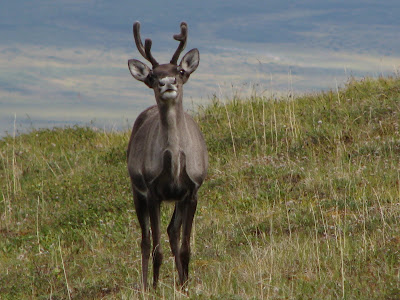
We had finally reached the border. We walked into the hills that were dotted with several hundred caribou in small clusters of twos, threes and fours. As we ascended, a young caribou with eyes as big and black as eight balls—who had never seen a human nor evidence of our destructive capacities—came within a first-down of us to assuage her curiosity.

The caribous' amber backs gleamed, velvet antlers rose regally, and when we startled a group of three around a mountain cliff, their tails shot up exposing a fleeing procession of adorable white asses. Their hooves clicked like tap-dancing shoes.

Caribou don’t appear to be constrained by the same laws of gravity that we are. When a caribou trots, it floats; their hooves barely gracing the ground.

There must have been 200 around us, migrating south, nibbling the tundra on the go. Oh how dear it is to watch animals exist unperturbed, acting how they’re supposed to act. What a world this would be if we could watch buffalo roam the same way in Iowa or see packs of wolves run through deserted suburbs, supplanted by forests that have reclaimed their rightful ownership of the soil.

I wonder if they'd be as enchanted to see us in herds at malls, baseball games, barn-raisings. I wonder what's going through a caribou's mind. Does it feel something akin to our notions of suprise, glee, sadness? Does it think about things and wonder as we do?

I was slightly envious of the caribou. They walk, roam, explore and eat for a living. They—at different points of the year—go from solitary travelers, to small family units and finally settle into their thousands-strong herds: the perfect blend of solitude, family, and community. But then Whitney brought to my attention the wolves, infant mortality rates, and the horrendous bugs that keep them on the run for most of the summer. After watching one caribou mindlessly harassing a ground squirrel, I thought roaming and eating, after a while, would get pretty monotonous anyway...

We walked back down to camp where we saw a red fox staring at us intently with a small, dead mammal in its mouth.


Day 6: Completion


A passing wolf swims across river unaware of our canoe just 30 yards away. It shakes itself dry, catches sight of us and lopes into the bush.

A ground squirrel on the bank barks at us and curiously watches us float by with the river current.

Caribou in happy families of twelve cross the river in dignified processions.

Wildlife abounds as the sun gleams down, coloring the water a delicious aqua blue. The dry air and sun beams make my lips bubble and turn Whitney's face a dark shade of pink. We meander with the river around plump green hills that are Wyoming-flat up top.

How did I come to be here?, I wonder. I am a suburbanite in the wild. Yet I feel more at home here than I ever did back in New York.

This is the way things should be, I think: the natural processes of a million different organisms, undisturbed by our technologies; our prowess for usurping natural kingdoms and replacing them with car-dealerships and soccer fields has been restrained.

There is harmony here. Sure, there is blood, guts and death. But there is harmony in the coexistence between the animals—their lives bound together by relentless competition and struggle. Hard lives, yeah. But at least—unlike their unfortunate relations held captive in zoos—these animals heed to one clear and simple purpose—the passion to survive—that most of us moderns, regrettably, never have to give a passing thought to.


[Thanks go to Whitney for most, if not all, of the photos]

Sunday, August 23, 2009

Rule of thumb #4: Avoid situations like being commissioned getaway-driver in the mission to traffic “Joey” out of town

Day 4: May 18, Tok, Alaska to Teslin, Yukon Territories (498 miles)


My goals were straightforward. They were:

I. Go home to New York
II. If possible, see my girlfriend Natalia in Oregon
III. Travel by any means necessary; hitchhiking preferably
IV. Never, ever, let my mother find out

I chose Josh, my good friend in Coldfoot, Alaska, to be my “base camp.” I told him that if I don’t call every seven days, then he should go ahead and alert the authorities. And if there is no avoiding it any longer, call my mother.

I wouldn’t wish such a scenario on my worst enemy. I might rather be abducted by a couple of horny hillbillies in Appalachia or be a play-toy in a grizzly den than have to call my mom with bad news.

My mom, an overly nervous woman to begin with, would not—to say the least—respond well to news about her son missing in the land of grizzlies and sasquatch.

While I didn't think it would ever come to that, at some point in my ride with Bobbie, however, I worried that Josh was going to have to make that call.

In Tok, the previous evening, I struggled to get a ride. I stopped at the town’s visitor center to ask where I could find a good spot to stand, but the lady warned me that Tok was a difficult town to hitchhike out of because it was so close to the Canadian border. She recommended I take a bus to Whitehorse in the Yukon, but that cost $125 and I didn’t want to resort to other modes of travel quite yet.

There wasn’t much traffic leaving Tok and the few drivers heading east didn’t bother to give a passing glance to my cardboard sign to "Canada."

The weather was still pleasant but the temperature was descending with the sun, which—in a month’s time—would still be hovering above the horizon through almost all hours of the night.

As I sat on my pack with my sign held on my knee, a transient black lab offered me companionship. His presence may have deterred the few trucks that passed from stopping, but I didn’t have the heart to shoe him away.

I gave up for the night and made myself a Mountain House Meal (freeze-dried food you just add boiling water to), set up my tent, and slept soundly on the side of the road. I woke early, around 7 am, cooked oatmeal with craisins and brown sugar with my backpacking stove, and made an even bigger sign, reading “Canada” in huge red letters.

The hours go by and I grow concerned. I figure no one wants to take a hitchhiker across the border, and the border itself is a two-day walk—an excursion I’m unwilling to undertake. Still, I’m comfortable, the weather is beautiful, and a scattering of birds sing me a panorama of song as I gaze at a frozen wave of white peaks to the south.

It’s approaching noon and I begin to fret about being stuck in Tok when a black SUV pulls over and someone yells out, “Hey Ken!”

What the hell?

Much to my disbelief, it’s a group of former coworkers from Fairbanks heading through Canada to Skagway, Alaska. Still a bit shocked—almost to the point where I struggle to keep my hands steady—I hop in, relay my few hitchhiking stories, and slug a couple Kokanee beers en route to Whitehorse, Canada—a quaint sub-arctic metropolis in the Yukon Territories, 400 miles from Tok.

I’m overwhelmed and can’t thank them enough. Patrick, the driver, buys me a coffee and bagel at Tim Hortons and forces me to take $40 in Canadian money. They drop me off on the highway, we hug, snap pictures, and go our own ways.

Whenever someone pulls over for the hitchhiker, especially after a long wait, the elation is almost difficult to bear. I can only compare the feeling to moments of unrestrained ecstasy experienced as a child: seeing a cluster of presents on Christmas morning or hearing that your elementary school is going to have a snow-day over the radio.

But upon being dropped off, the anxiety is equally as potent. The hitchhiker wonders how long he’ll have to wait, where he'll sleep, and worst of all: whether he’ll ever get a ride.

It’s around 8 pm but there’s still plenty of daylight so I make my sign for the next sizable town, which is Watson Lake—just north of the British Columbia border. I stand out there for an hour, sit down to look at my maps, and was delighted when Bobbie pulled over in her sedan.

Bobbie was a native girl, heavyset, pushing at least 250 pounds. She was in her late twenties, very cheery, and was hoping to pick up a hitchhiker to keep her company. She asked me to help her move some party supplies out of the back seat into the trunk (she was hosting a baby shower in a town called Teslin). When I motioned to move the large bottle of liquor and various six-packs of wine-coolers, she exclaimed, “No, no. Keep those up front for me.” Luckily—for my sake—she gave me the keys and I was to take her the 100 miles or so to Teslin.

She pounded one wine cooler after another, and refused to shut the windows because it makes her feel claustrophobic.

“I’m a Yukon girl,” she’d giggle, while I shivered feverishly in my hoodie.

As we sped down the highway she interrupted, “No. Wait, wait, wait. Turn here at this campground. I got some friends I want to meet here.”

This is it, I thought. This was her plan all along. This is when she and her cronies throw me out of the car, steal my gear, rip off my clothes, and jam some non-cylindrical object into me while laughing and giving each other high-fives.

I knew that hitchhiking wasn’t exactly safe. Yet I thought if I kept my wits, used common sense, and at the very worst, was quick to retrieve my hunting knife, then I just might escape this adventure alive.

I was willingly putting myself in hazardous situations, probably for the same reason people go sky-diving, or mountain climbing. There’s a thrill to hitchhiking. There’s a lot of boredom, a lot of monotony, but there are, without question, thrills.

Bobbie said hello to a couple friends at the campground—without event—and we got into the town of Teslin around midnight. She said I could stay at her friend Marie’s place and though I felt uncomfortable with the offer, a warm bed sounded enticing.

Teslin is small community primarily made up of natives, a few whites, and an unverified number of sasquatch. Infamous in the Yukon for its high number of Bigfoot sightings, nine Teslin residents in 2005, according to CBC News, saw a large, hairy, human-like figure walk past a window. This has not been the first sighting, and I doubt, the last.

When we got there drunks strutted across the street yelling obscenities. I immediately felt uneasy. By the time we got to her friend Marie's, Bobbie was thoroughly soused and urged me, ceaselessly, to take a shot of whiskey, all of which I politely declined.

Marie—a well kept, attractive middle-aged woman—looked at me warily, probably wondering if I’d slice her throat open in the middle of the night. I didn’t take offense, though. I probably wouldn't want me in my house either.

Bobbie had other friends in town so I chauffeured her to Alex’s. She slugged a few more beers and every so often she brushed her hand against my thigh.

We couldn’t tell whether Alex was home or not because of the freakishly-large dog in front aptly named Zeus who looked like one of the ghastly Zuul dogs in Ghostbusters.

Bobbie prodded me to go knock and I responded, sternly, “Bobbie—I don’t care if I sound scared or girly right now, but I’m not going anywhere near that dog.”

We then visited Joey—a middle-aged native with sleepy eyes—who, to make things so much more complicated and scary, was under house-arrest. The police drove by every few minutes to make sure he was still home, while I nervously sat on his couch watching a TV show called “Kenny vs. Spenny.”

I was in a difficult situation. I wanted to get the hell away from Bobbie, Joey, Marie, Zeus and Teslin altogether. I wanted to be at home in my waterbed, safe and sound.

Hoping to get away, I told Bobby that I’d be happy to sleep in my tent but she fervently insisted that I’d have my own room.

As the night dragged on, Joey and Bobbie hatched a plan to get Joey out of town. If Joey slipped around the woods undetected by the police, we could pick him up in Bobbie’s car and party it up at Watson Lake where Joey would have access to his beloved alcohol.

I had no part in the creation of these plans, and while I tensely listened, they designated me as the getaway driver because we had a bottle of liquor in the back and sober people were scarce.

Bobbie wanted to go see another friend before we trafficked Joey out of town so before dropping her off I said, “This has been wonderful and I really appreciate the ride, but I really should go my own way at this point.” Finally she gave in. It was dark and I was cold. I walked along the highway and found a patch of grass to set up my tent for the night.