Monday, July 25, 2011

National "scandal"


I’m excited to report that my best friend, Josh Pruyn (who’s been mentioned a dozen or so times on this blog), is at the center of a national “scandal."

Let me back up and give you Josh’s story (which is, in many ways, my story).

I’ve known Josh for about 22 years. We go back to when we played in the same youth ice hockey league at the age of six. A couple years later, he moved into my suburban neighborhood where we played street hockey on an almost daily basis after school for the next ten years. (I challenge any duo in the world to beat me and Josh in a street hockey match.) I’d say we became best friends late in high school when we used the newly discovered “email” as an outlet to complain about our unremitting sexual frustrations.

We dormed together for a year at Alfred University. He stayed and I transferred, but we kept in touch via email, still mostly complaining about our unremitting sexual frustrations. But we also began to discuss other, more substantive things: nature, religion, morality, politics, goals, dreams, failures, insecurities. Everything. I don’t know how many emails we've sent to each other since our late teen years, but from 2005 until today we’ve sent a total of 1,750 emails to each other, which averages out to sending and receiving an email every 2.5 days. (I know, it’s a little weird.)

I left college with $32,000 in debt and a history and English degree. He left with $66,000 with a history and political science degree. Needless to say, we no longer complained about women anymore. Our debts were the only things on our minds.

(Me drunkenly embracing Josh on my 21st b-day.)


(Josh came up to work up in the arctic for a bit. Together we burnt and then hauled the Yukon River Camp's summer garbage down to a dump in Fairbanks.)

I got a job with Coldfoot and, later, the Park Service. Josh, too, tried to enjoy the itinerant lifestyle, jumping from job to job for a while at places like Coldfoot. But because there were huge gaps in between his seasonal employment, Josh had trouble keeping up on his loan payments, which were far more demanding than mine.

He needed something more permanent, so he moved to Denver and took a job as a “admissions representative” with an online for-profit school called Westwood. At first, Josh was excited to be working for a college. He figured he’d be inspiring young people to go to school and improve themselves. (His job, essentially, was to get prospective students to sign up for classes.) But the more he learned about Westwood, the more he found himself in a moral quandary.

Here’s the thing about most online for-profit schools… They’re mostly a scam. They often cost around $70,000 for a three-year degree. Because they’re nationally-accredited (which is very different from a regionally-accredited school), students cannot transfer their credits to normal universities. And most employers don’t take their degrees seriously, so they can’t get jobs, either. Places like University of Pheonix and Kaplan and Westwood are putting many many young people in terrible, terrible debt that they can’t get out of.

Josh, as an admissions rep (which made him little more than a glorified telemarketer), began to see what was going on around him. Many of his fellow coworkers were lying to or misleading prospective students. Those who got the most students to sign up were rewarded with vacations to Cancun, parties, bonuses… At an employee celebration, one coworker laughingly received a “Best Liar” award. Those who didn't sign up students were fired. It was cruel irony that, to pay off his debt, Josh was now in the business of putting other young people into debt.

After five months, Josh ended up quitting. This is where I come in (and where I play a very minor role in this narrative).

I moved to Denver to stay with him and his girlfriend for a couple months (right before I bought a van and enrolled at Duke). After hearing Josh’s horror stories about Westwood, I wanted to publish an exposé on the school’s unethical practices. I wanted to bring Westwood down. (It was an unrealistic goal, as I'd published just a few very minor professional articles at that point.) I spent a couple months emailing ex-professors, ex-students, and ex-administrators from Westwood. I wrote a great article, but no one wanted to publish it (which frustrates me to this day).

While researching, I discovered a law firm that was representing former Westwood students, who were suing the college. I got some info from the lawyers and told them about Josh. They began talking with Josh. Josh told the lawyers the many gory details about what happens on the Westwood sales floor.

So when Senator Tom Harkin (Democrat/Iowa), who was conducting a hearing about the crimes of for-profit trade schools, found out about Josh and his experiences at Westwood, Harkin asked Josh to testify in front of the Senate.

Josh flew to D.C and, last fall, delivered his testimony about Westwood. It was his shining hour, his redemptive moment. (To watch Josh, fast forward to minute fourteen.)


Let me fast forward to the present day. The Daily Caller a conservative online newspaper founded by journalist and dweeb Tucker Carlson, has printed an exposé on Josh and Senator Harkin, claiming that Harkin and his staff “supplied an answer” to Josh. For some delusional reason, people representing Westwood claimed that Josh was working for the law firm that was suing the school—a bullshit tactic employed to hopefully discredit whatever Josh had to say at the Senate testimony. Needless to say, Josh has no connection with the law firm. Josh merely wanted to expose Westwood’s bullshit. He wanted to do the right thing. When Harkin's aide advised Josh via email, the aide was merely reiterating what Josh had told him. (PS: I'm the "freelance journalist friend" mentioned a couple times in the exposé.)

You’d think that being at the center of a national controversy would be stressful and chaotic for someone like Josh, who now has a big, ugly, warty evil corporation breathing down his neck. But for the most part, he and I couldn't be more amused with the whole thing. Josh is still in student debt, so he really has no money or valuable assets that Westwood can take. Plus, he’s right, and Westwood (and The Daily Caller) is wrong. Plus, it's fun to think back on when we were a couple of losers in high school who've each had our fifteen minutes of fame.

Tuesday, July 19, 2011

Writer in residence


For a little over a month, I’ve been Coldfoot’s writer-in-residence—a title I use reluctantly because I’ve actually done very little writing on this blog in that timeframe. I’ve mostly been writing my book. And when I say “I’ve mostly been writing my book” I mean: “I’ve mostly been procrastinating writing my book.”

Confession: I am a master procrastinator. And I don’t mean that in a funny, cynical, sarcastic way. I could teach classes on how to procrastinate. A procrastinator who knows what he's doing knows how to procrastinate efficiently. When I have something important to do, I find myself unable to do the important thing, yet I am exceptionally good at getting secondary, semi-important things done.

So just exactly what have I been doing? I have indexed my whole 140-page “quote collection,” which is on a single-spaced Word file. To retain the insights and ideas from the books I’ve read these past three years, I’ve been collecting and saving quotes in this file, typing out each interesting passage that I think might be of some use to me in the future. Before I indexed them, my collection was little more than a confusing, unorganized jumble of words. I’ve taken it upon myself to, this summer, read every single quote and assign to each an index heading (i.e. “wilderness,” “travel,” “agriculture,” etc.) to be placed under its proper index heading on a separate document.

While I was working on my index on my laptop, one of my female coworkers asked me “how’s the writing’s coming?” I said I’m not writing but that—with no shortage of pride—“I’m just indexing 140 pages of wisdom,” adding that these quotes represented all the topics under the sun that are “the most important to me.” I wanted to impress her with my diligence, so I opened up the index file on my computer, and, on the top of that page—in large, emboldened, 20-point font—was the word “MASTURBATION”—one of several hundred index headings. For the record, “masturbation” is not a topic that I consider of the utmost “importance” to me, but I decided to give it its own section because Jean-Jacques Rousseau has some curious opinions on the matter that I desired to preserve. (PS: If anyone wants a copy of my index, let me know via email and I’ll be happy to send you one. I’ll be done with it in about a week.)

I’ve also gone through 112 pages of my book's “scrap file” on which I've pasted hundreds and hundreds of passages of crappy writing that I wanted out of the book, but didn't have the heart to delete because it had some value to me. I’ve culled this file down to 79 pages and reorganized every passage under the appropriate chapters so I can easily reincorporate passages into the book if I choose to.

And when I ran out of things to procrastinate, I finally buckled down and edited my first seven (of twenty) chapters.

Another confession: Before I undergo an editing session, I read a chapter of Elizabeth Gilbert’s Eat. Pray. Love., which—I’m embarrassed to admit (as a young, straight male)—is a masterfully written travel memoir that I really, really like. And because I’m in the business of writing a travel memoir, I figured I ought to learn from the best. There are few authors who are able to come across as both sincere and self-deprecating, who make you laugh and cry. Gilbert’s one of them. It’s an incredibly difficult balance to strike—being both stupid and serious—but it’s a magical thing when a writer pulls it off. And by reading her book, I’m able to “Gilbertify” my own words, helping me express ideas colloquially without dumbing anything down.

The real reason I haven’t been writing on this blog is because I’ve been bummed out lately—I’ve been bummed out for quite a while in fact. And while sharing bummed out stuff—which is normally juicy stuff that is sometimes the most fun to write and the most enjoyable to read—I’ve decided to withhold my petty troubles from you, dear reader, because my troubles, currently, aren’t of the interesting sort.

Mainly, I’ve been stressed out about the book: Is it going to happen? Am I just wasting my time? Is my story even worth telling? What am I doing sixty miles north of the Arctic Circle? And while I have tons of reasons to moan about my previous literary agent (who stopped responding to my emails), I’m just not going to go there, as complaining about your agent is just one short step away from whining about my assistant Brant who got me a soy latte when I specifically asked for a Caffe macchiatto. In other words, these are boring, privileged travails—not the sort of travails I want on a blog that I’d like to be about travel and adventure and poverty and journeying and important stuff.

And while I’m still very unsure if the book is going to happen, I am pleased to report that I’m beginning to drub up interest with literary agencies. So we’ll see. I plod on.

***

I just told someone the other day that “I love being unemployed.” It’s not exactly true that I’m unemployed, as I work about eight hours a week, and last week—because a guide had gone on vacation—I worked close to thirty, allowing me to bring in about $500 between salary and tips—but, for the most part, yes, I am unemployed, and goddamn, do I love being unemployed.

“Unemployed” is probably not the best way to describe my current status because I most definitely am employed with book-writing (when I’m not procrastinating it), so I suppose I mean: I love being self-employed. I love working on projects of my own creation; on a schedule that I've devised. When work is fun (which the book is for the most part) work is no longer work. Work and leisure become one and the same thing.

As much as Ken the wannabe scholar likes writing, Ken the wannabe wildman feels ignored. Truth is, I’ve spent most of the past three years sitting on my ass in front of a computer. And while I'd rangered for a couple summers and farmed a little bit, I was, for the great majority of that time, sitting on my ass, too. (My ass, as I type this, is quite literally sore from being planted on a chair for so long.)

I’m convinced that 18-year-old Ken (who played on his varsity hockey and football teams) could kick 28-year-old Ken’s ass. Which is kind of sad to think about because I could easily be at my physical peak today if I wished to be. And I guess I’m starting to think that I ought to take advantage of my youth, and go on some once-and-for-all limit-testing physical adventure and use my body to do things I know I won’t be able to do in twenty years. In other words, I want to get off my ass and do something. I want to finish this damn book.

Plus, I find that the whole memoir-making process is kind of fucking with my memory. Let me explain… In order to write a memoir, you must first take actual, real-world experiences (like hitchhiking with a driver in Virginia) and then translate that experience into words that are arranged on a page. (This is the first time you tinker with your memories.) What goes onto page, of course, will never be a perfectly accurate rendition of the original experience because the event that actually happened and your memory of that event are two very different things. Then you have to rearrange those experiences—which are now on page—so that they make sense and are interesting to your reader. For instance, I’ve had to cut important people in my life out of the book because they don’t contribute to the central narrative, or I’ll have to play around with dates a little bit so as to create moments of suspense. (This is the second time you tinker.) Here's the F'd-up part: I find that now, when I think of my actual experiences, I no longer think of the actual experience; rather, I think about how I’ve rearranged it in my book. I am disfiguring my memories. I suppose this stinks because I no longer see things the way in which they actually happened, but in a weird sort of way, I think I am restructuring my memories in such a way that makes my “story” make more sense. I once heard that all we are are our stories. While my story may no longer be real (and remember no one’s story is perfectly real because all memories are imperfect), my story, now that it’s been disfigured, is better than ever.

All in all, I feel like I’m living in the past. I’ve been writing my story for, off and on, eleven months, and I feel like I can’t move on and can't create new memories until the book is published. It’s not that simple: I am meeting new people and seeing new stuff up here and having new experiences, but I am far from fully living. After this book, I think I’ll be emptied of stories, yet more than eager to fill up on new ones.

Tuesday, July 5, 2011

Hike on the continental divide


I recently went on a two-day hike with my friend Sarah on the North Slope of the Brooks Range, about 30 miles north of the northernmost tree. It amazes me how such a desolate, barren, and empty place can still be appetizing for the eyes. You'd think that an endless vista of 7,000-foot rock piles--bearing only the most resilient patches of moss and lichen--would produce sensations of disgust and repulsion. But oh no. While the wavy green grass of a well-cared-for pasture entices us with fertility, and the jungle, biodiversity, the desolation of the Brooks bedazzles us with a different kind of beauty; the kind that--through awe and wonder--sets our imaginations astir.


We drove up the Dalton Highway in a truck my friend Chad lent us, before parking atop Atigun Pass--which is a mountain pass that's also along the continental divide. (If a water droplet split on the pass, half of it would head north to the Arctic Ocean, while the other half would wiggle south to the Yukon River before being poured into the Pacific.)

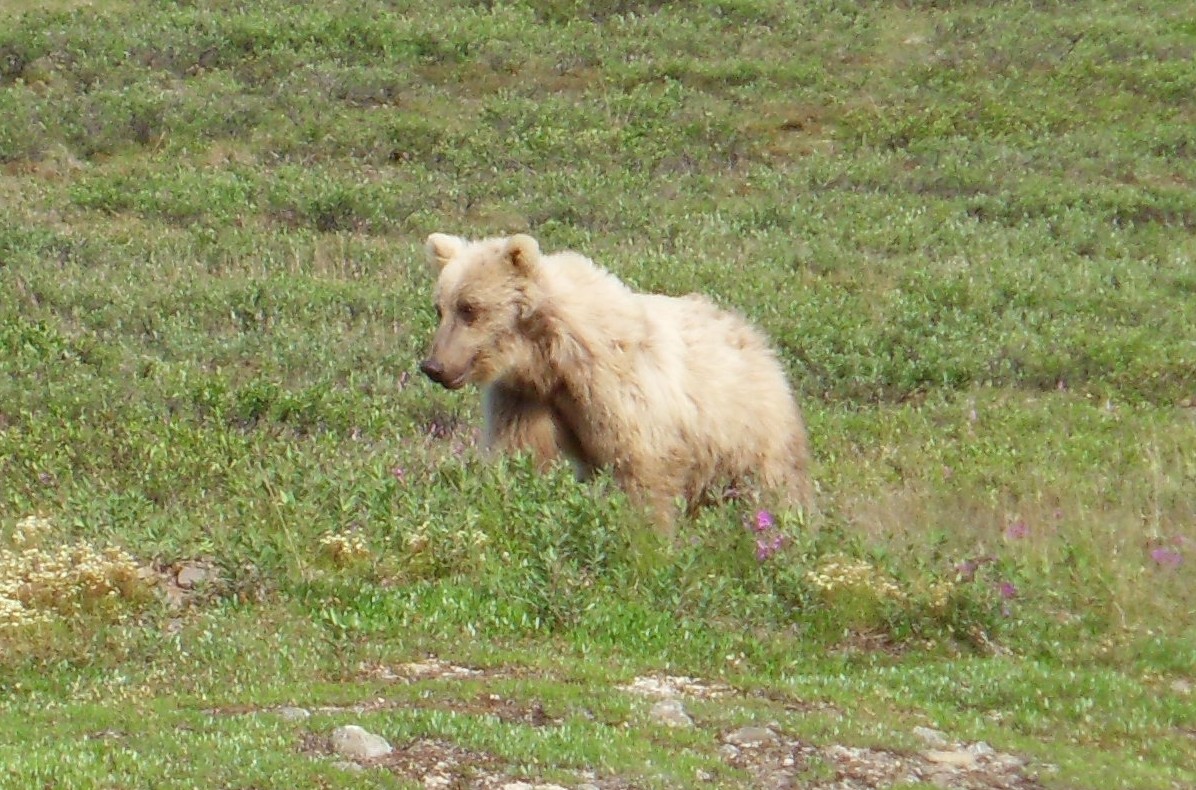
We came across a grizzly crossing the road near a place called Chandalar Shelf. It walked into the grass and began scraping off layers of tundra either with hopes of pulling out an edible root or a ground squirrel to snack on.


The mountains we climbed were around 6,500 feet, though we started at a relatively high base: something like 4,500 feet. From the picture below, you can see the Dalton Highway snaking across the valley.


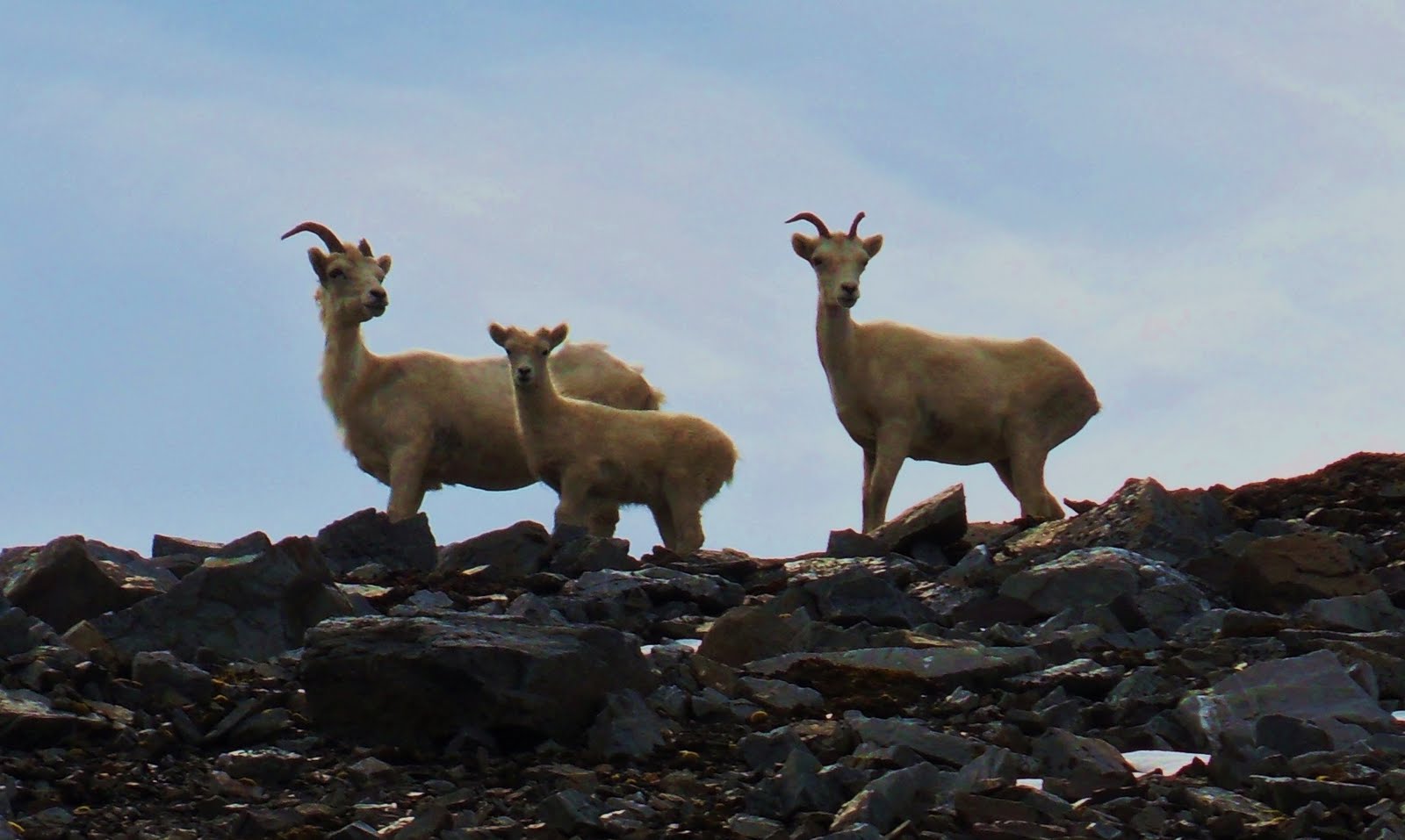
A band of Dall sheep choose to inspect us from above. The stared at us curiously and motionlessly. They seem to have rather stoic dispositions, despite their keen curiosities.


On the trip back, I slipped on some ice and fell into a small creek. For the rest of the way back, I had a small stone stuck in my finger, which I didn't want to pull out until I had my first aid kit supplies at hand. (Finger was fine.) Much to my disappointment, though, my camera, which was in my back pocket, has been severely damaged, so I regret to say that my pictures will be severely reduced in quality until I buy a new one. (Which is atop my materialist desire list.)

Tuesday, June 28, 2011

Slate Creek Trail

Recently, I set off on a two-day, 24-mile hike down the Slate Creek Trail--the only trail anywhere near Coldfoot. Nothing dramatic happened, but here are a few photos.


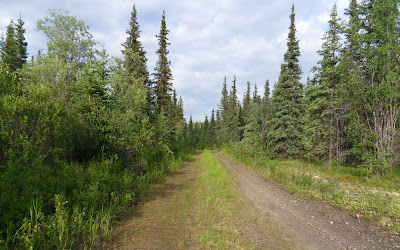
The Slate Creek Trail (also called the Chandalar Trail) is a mining road. There is still some mining activity in the area. Four-fifths of the trail was graded smooth by the large trucks they drive to their mines from Coldfoot, but one-fifth of the trail was purely in the Creek, so I had many, many creek crossings. (Nothing too taxing, as the water level never rose past my knees.)


Wolf scat. I also saw tons of moose prints and several grizzly tracks.


The creek was narrow, meandering around cliff faces like the one above, but after rounding a corner I came upon a giant ice field, called "Aufeis," which is layered ice that, as the temperatures warm, melts into a creek or river. I walked atop the ice and could hear water gushing beneath me. Sometimes I'd hear the crash of thunder, but it only hunks of ice plopping into the creek bed somewhere else. In places, there are little creeks atop the Aufeis, like the one below, which had a yellowish tint for some reason.


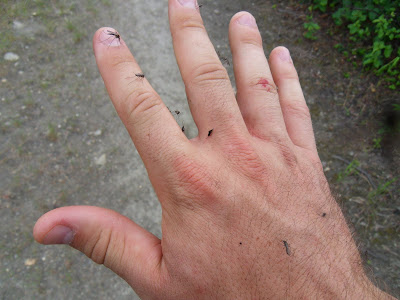
After getting off the ice, the mosquitoes attacked me at once. I wore a headnet, long sleeves, and and pants, so they focused mainly on my hands and on my deltoids, where my backpack stretches my shirt tight against my skin, making it easy for them to get through my clothing. I had to slap my shoulders every few seconds, killing 10 at a time, leaving the jellied remains of fruitless genocides on my shoulders.

The pictures below don't do justice to how bad the mosquitoes are in the arctic. (FYI: They're especially bad in the arctic because beneath the ground there is a layer of "permafrost," or frozen ground," which prevents water from seeping through, as it does everywhere else. Because of the permafrost, puddles and ponds and lakes form everywhere, which is perfect habitat for those sons of bitches.)


Here's my tent which I set up atop a knoll next to my destination: Winer Lake--the headwaters of Slate Creek.


I love being in my tent because then it's my turn to torment the mosquitoes. When they're inside, they're easy killing. I like to catch them on my screen door, because when I swipe them across it, it's like running them over a cheese-grater, and they're easy to dismember. Sometimes, for those who haven't gotten in, I hold my arm just millimeters from their noses, just to intensify their blood lust and get their panties in a wad.


Can you espy the moose?

Saturday, June 25, 2011

How to hitchhike FAQ


I’ve recently been trading emails with a young man who is thinking about hitchhiking up to Alaska. Inspired by those emails, I’ve decided to write this “how to.” I’ve styled this entry as an FAQ, though I should note that I haven’t actually been asked many of these questions, and I certainly haven’t been asked them frequently.

I should also note that while I have hitched for over 8,000 miles across many states and provinces, I do not, by any means, consider myself an “expert.” For anyone looking for serious hitchhiking advice, I suggest digihitch.com, which is online community of hitchhikers—many of whom make my mileage look miniscule.

*One more word about this post before I get to the actual advice: I believe that sometimes one can over-prepare before embarking on an adventure. Sometimes we plan and prepare so much that we feel obligated to take the path we planned rather than the one fate seems to want us to follow. So I offer this advice with some reluctance as I feel that “learning on one’s own” is one of the greatest joys of doing anything. But sometimes one needs a push, or someone to say “It’s possible; you can do it.” So this post is my way of saying “It’s possible; you can do it.”

**Okay, one more word. This post would more accurately be titled “How to long-distance hitchhike through the U.S. and Canada” because I know nothing about hitching elsewhere. If you plan on hhing through Europe or South America or anywhere other than English-speaking North America, I strongly suggest getting advice elsewhere.

I’ve asked many of my drivers, out of curiosity, “Why did you pick me up?” The advice I give below is based entirely on the answers they gave in addition to the tactics I used that contributed most to my success.


Is hitchhiking easy?

Yes. Very much so. I went on a 5,500 hitchhike (hh) from Alaska to New York in 2007 in fourteen days, and 2,500 miles from Mississippi to New York with my then-girlfriend in 2008 in 25 days (we were in no hurry). I’d posit that anybody can hitch a ride, but, like anything else, it gets easier the more you do it.


Where should I hitch rides?

Firstly, you want to do it in relatively safe places, like a thruway rest stop, a thruway entrance ramp, or on a highway just outside of town. You want to be in a place where you’ll feel safe even if you don’t get a ride by nightfall. In other words, you don’t want to be close to a city, where there are little to no places to camp.

It’s crucial that you pick a place where:

(1) The driver is going slow enough to see your sign [ideally less than 30 mph], and
(2) the driver has plenty of space to comfortably pull over going at that speed.

(Drivers, of course, are going very slow on ramps and at rest stops.) Just after a stop light at the end of a town or city is also a good place because, at that red light, they will be able to see your sign and get a good look at you, affording them a moment to contemplate picking you up.


Should I use my thumb or sign?

I’ve used my thumb only once or twice. I’ve been told and I’ve discovered that it takes a lot longer to get a ride using only your thumb. Instead, I strongly encourage using a sign. A sign communicates a couple things to your driver: it says that you’re not just some aimless drifter, but that you’re going somewhere and that you have a plan and that, because of these things, you’re likely to be more responsible and trustworthy. Plus, when the driver sees the town’s name (“Charleston”), and recognizes that he’s going to or through that town, he’ll be more likely to help because he knows he will be able to help.


How do I make a sign?

Find cardboard. You can get cardboard at any gas station or McDonalds or just about wherever. Just ask someone working there for an old box, and they’ll be happy to give you as much cardboard as you want. Make your signs really effin’ big. Use the whole box. They should be, at minimum, two feet tall and three feet wide. The bigger the better. And your writing should be very big and legible. A black marker will work, but I use crayons because

(1) there is no ink so you won't run out,
(2) the colors are more eye-catching, and
(3) they communicate friendliness to your driver in a way that a black marker can’t.

Always think about your driver. To pick you up, he needs to see

(1) where you’re going based on your sign, and
(2) he needs to get the impression that—from the looks of you—you won’t kill or harm him. So having a big legible sign makes things easier for him.


What town/direction should I make my sign out to?

There is a complex art to this, which you’ll learn by trial, error, and common sense. If you’re going 1,000 miles in one direction, sometimes it’s a lot easier to use one directional sign (“north”) over and over again, rather than making a new one for every next town on the map (“Charleston”). Drivers, sometimes, will not like the ambiguous nature of a directional sign; they might be more likely to pick you up if they recognize the town written on your sign.

If you’ve been stranded on the side of the road for an unreasonably long time, it might have a lot to do with what you’ve written on your sign. (Always have an extra square of cardboard.) On my hh from Alaska to New York, it would have looked ridiculous to put “New York” when in Tok, Alaska. (I put “Whitehorse”—the next big town—instead.) If I wrote “New York,” drivers will either think I’m crazy or that there’s no point in picking me up since they aren’t going nearly that far. In cases like these, you’re better off writing down the name of the next big town.


What should I take with me?

Firstly, you must learn a little bit about where you’re going. If you’re headed to Fairbanks, Alaska in October, you must prepare for very cold weather. If you’re going to Seattle, you better have a poncho and a pack cover. I’d recommend checking out the average “low temperature” for the coldest place you’re going at that point in the year, subtract 10 degrees from it and then make sure you have the gear to survive that. (And presume there will be freezing rain at the same time.) If you prepare for the worst, you’ll be fine.

It is good to have a pack with you. If you’re hitching without a pack, drivers will think you’re some aimless, pathless drifter and be less likely to pick you up. (Several drivers have mentioned this to me.) And a pack, of course, will help you prepare for a variety of situations.

Think of hhing cross-country as just a really long camping trip. Obviously, where you’re going—whether it’s hot or cold, or wet or dry—will alter the contents of your pack, but, if I were heading up to Alaska in the summer, I’d carry the following:

Clothes:

Gloves
Winter hat
Baseball cap
2 pairs of pants (jeans/khakis)
2 nice shirts (button up or polo)
2 white tees
Set of long johns or polypro
Jacket
Rain suit
3 pairs of underwear
3 pairs of wool socks
Boots or sneakers

Gear:

Water bottle
Backpacking stove
Propane canister
Tent
Sleeping bag
Tarp (at least 6x8 ft)
pocket knife
headlamp
lighter/matches
cell phone
weapon
industrial garbage bag (to cover your pack in the case of rain and if you don’t have a proper pack cover)

Toiletries:

Soap
Shampoo
Razor and shaving cream
Toothbrush and toothpaste
Deodorant

Misc:

Maps of places you’re going (absolutely essential)
Book for reading
Camera
Crayola crayons
Journal
Wallet with $200
Passport

Food (two or three day’s worth):

Noodles
Breads
Nuts
Granola, etc. etc.


What should I wear?

If you want to get an office job, you’re going to have to show up at the interview in a suit and tie. If you want to hitch rides, you may, similarly, need to acquiesce to the requirements of your driver. That means you gotta dress up a bit.

I make sure all my clothes are clean and reasonably unwrinkled. I tuck my shirt into my pants, and wear nice shirts like polos and button ups. Remember: you want to look innocent and harmless. Of course if you’re in a hippyish community where tattoos and piercings and smelly armpits are the norm, you’ll have no problem getting a ride, regardless of the cleanliness of your garb. But good luck getting a ride in the Midwest.

There are plenty of places to wash up along the way. Motels will sometimes let you pay just a couple bucks for a shower. You can also buy a shower at truck stops. If you’re clean and smell okay, not only are you more likely to get a ride, but the driver will be more likely to give you a longer one.


How can I better my chances of getting a ride?

Again, you want to look innocent and harmless. You can get a ride by sitting on your pack with your sign, but I think you’re better off standing since it’ll make you look less tired and lazy. Always think of your posture. And be sure to look pleasant. You don’t have to smile, but whatever you do, don’t look bored or angry or sad or frustrated. I’d say try to look somewhere in between neutral and happy.

Prepare to be frustrated. Hundreds of cars will pass you without so much as looking at you. But never show your frustration by kicking the ground or swearing or anything that might communicate anger to passing drivers. (In many cases, drivers who saw me turned around after going up the road a bit, only to come back and pick me up. If I had in some way expressed resentment over their initial snub, and they saw it, they never would have turned around.)


Is hitchhiking fun?

God no. Well, sometimes. Realize that, at times, you will have to sit or stand on the side of the road for 12 to 24 hours, sometimes in miserable weather. This is of course extremely boring and tedious and frustrating. Though, it’s arguable that it’s all worth it when someone finally pulls over.


How long should I expect to wait?

This is hugely dependent on two things:

(1) The town/state you’re hitching in and
(2) luck.

In many areas of the country, hitchhiking is still fairly commonplace. In Washington state, I rarely had to wait more than 20 minutes, but in places like Florida or Connecticut—where it’s not so common—I waited more than two hours for a ride. The most I ever waited was 12 hours in a town in the Yukon Territories; the least was less than a minute, both in British Columbia and Vermont. Ultimately, though, I think you can expect to wait 30 minutes to two hours.


How much money should I bring?

If you’re making your own food and sleeping in a tent, you don’t need much. I wouldn’t bring more than $200, plus a debit card. Even though no one has ever tried to rob me, I think it’s helpful to presume that someone will. This way, you won’t bring expensive items like iPhones and laptops and worry about them the whole time.


Do drivers expect anything in return?

No. If they need money, they’ll ask up front. (These are usually the rides I turn down, anyway.) Most drivers only wish to experience the joy of helping someone and the pleasure of having a captive listener. So be thankful—and be sure to play up how much they’re helping you—and be a great listener. I’ve extended many rides by being interested in their life stories (either genuinely or not).

Many times I’ve bought my drivers meals if they picked me up when I was standing in miserable weather or if they took me a far distance or if they went out of their way to drop me off somewhere. This is not required, but it always made me feel better about taking the ride.


Is hhing dangerous?

I think, in general, the level of fear and paranoia most Americans experience is not in accord whatsoever with the actual level of danger out there. In other words, our nation (and hhing) is safer than most perceive it to be. That said, there are still risks of course. When you get in someone else’s vehicle, your driver can easily, say, pull out a knife or gun and make you give him your money or do stuff you don’t want to do. (This never happened to me, but it’s worth considering.)

To decrease the chances of this, do the following:

1. hh in places where there are lots of passing cars (rest stop), which will make a would-be bad guy less likely to screw with you in open view.

2. Don’t hh at night. No one wants to pick someone up at night anyway.

3. Trust your gut instinct. Have a short conversation with your driver before getting in. Ask where he’s going. You only have a split second to determine if he’s a good guy or not. If he even, in the slightest way, gives you the willies, do not get in. (I’ve turned down maybe half a dozen rides because of this.) Just say “No thanks” or that “I’m actually going a lot farther than that” and they won’t be offended. If you have below-average “people reading” skills, don’t hitchhike at all.


Is it dangerous for women?

I don’t know if it’s appropriate to say it’s dangerous for women, but it’s certainly more dangerous for women than it is for men. It should be noted that most drivers are males, either for male or female hitchhikers.

I once hhed with my then-girlfriend for 25 days and we didn’t have any problems, but a couple passing drivers made lewd sexual gestures at her, so if she were alone, such and such a person could very well have been her driver.

While hhing solo is certainly possible, to ensure safety, it would be ideal to travel with a partner (male or female), and I’d strongly suggest carrying an easily accessible knife or can of mace. Also, it helps to call someone or text someone in front of the driver while on the drive, which will also deter crime.


When should I decline a ride?

You should obviously decline a ride if, as mentioned above, you're at all creeped out by your would-be driver, but there are other reasons to do so as well. And this is where the "art" of hitching rides comes in because sometimes—to get where you're going as quickly as possible—it's better to stay put rather than taking a ride.

Consider the following situation: You're on the outskirts of a hippyish town accepting of hitchhikers. The place where you're standing is safe and a large number of vehicles are heading in your direction. There's plenty of room for them to pull over. In other words, you're in the perfect spot to hitch a ride. If someone pulls over and offers to take you six miles when you're trying to go 300, you might be better off declining the ride and waiting for a longer one. You can get dropped off—at this place six miles up the road—and it can potentially be the worst spot to hitch rides out of. In other words, if you know you're going to get plenty of offers, wait for an ideal one, because willing drivers may be few and far between elsewhere.


Where should I sleep?

I carry a tent with me. In many towns—in Northwest U.S., Alaska, or Western Canada—I set up my tent in open view of the road, and felt safe doing it. There are still lots of places where sleeping on the side of the road in a semi or RV or tent is normal and safe. Of course, in other places, it’s weird, and it will give cops cause to harass you. In these cases, you can slip into the woods where you and your tent will be concealed. (Near thruways, there are always woods.)

If you’re stuck in the city, I’d splurge on a hostel or try to find a church or homeless shelter, or even call the cops before trying to sleep in really sketchy places.


What about hhing with groups of people?

It’s easy to hh as a solo male or solo female, or as a male and female couple, or as a female and female duo. But any other combo, I’d guess, would be far more difficult (like two or more males.) Between the people and gear, many drivers won’t have the room to support three hitchhikers. And there’s a certain risk with picking up two males since the driver knows he could be overpowered if the occasion called for it.


What are some other ways to get rides?

You can always ask for rides at truck stops and whatnot. If you’ve been stuck for a while, it might make it a lot easier to offer to pay for his coffee or meal.


Is hhing illegal?

Yes. In many places it is. Hitchhiking is not exactly—from what I know—wholly prohibited in any one state, but there are many places in those states where it is. For instance, hitching on thruways is illegal almost everywhere, except Oregon I think. (However, hitching on thruway entrance ramps is legal in most places.)

I’ve been approached by cops in states like Mississippi, Alabama, Florida, and New York among others—and have been told by all these cops that hhing is illegal and that I can’t be doing this—BUT they almost always let me go and wish me well.


How should I deal with cops?

Kindness and honesty go a long way. Be sure to have an ID to give them so they can run your name through their system. When they realize that you’re clean, you’re usually good to go. If they tell you hhing is illegal, act surprised and be apologetic, and tell them you’ll never hh here again (which will probably be true). Most times they don’t mind too much since they know that, in an hour, you’ll likely be out of their district.

If they’re adamant about you not hhing there, tell them that you’ll find another way or that you’ll walk. (There are no anti-walking laws (except on thruways and some highways)). And once you’re a good ways away from them, you can probably pull out your sign and hitch a ride before the next cop finds you.


Should I hitch on a highway or thruway?

If you’re going for speed, definitely the thruway. You can probably cross the country in under three days if you’re lucky. If you're going for culture, use the highways and seldom-used country roads.


Is it possible to hitchhike in a city or town?

I wouldn’t even bother trying. Go to the very edge of town, where there’s less traffic, and the only traffic is outgoing traffic. If in a city, take a bus or train to the farthest suburb or country town where hitching rides and finding safe places to camp will be easier.


At what time of day should I stop hitching rides?

The last thing you want is to get a ride at dusk and then get dropped off somewhere at night. You want to set up your camping site well before the sun drops, so you can identify safe and concealed places. Obviously “nighttime” depends on the place and time of year, but, in general, just don’t put yourself in a situation in which you need to set up camp in a dark, unknown place.


Any last words of advice?

You’ll never learn exactly how to do it until you, yourself, go out and do it. So don’t worry if you’re not 100% prepared. After all, you can’t have an adventure without the unknown. At the very least, just carry enough clothes to stay warm and dry and you’ll more than likely be fine.

***

If you have advice of your own (or disagree with any of mine), please feel free to comment in the comment section. If you have other questions, please ask away, so I can update and expand this FAQ.